
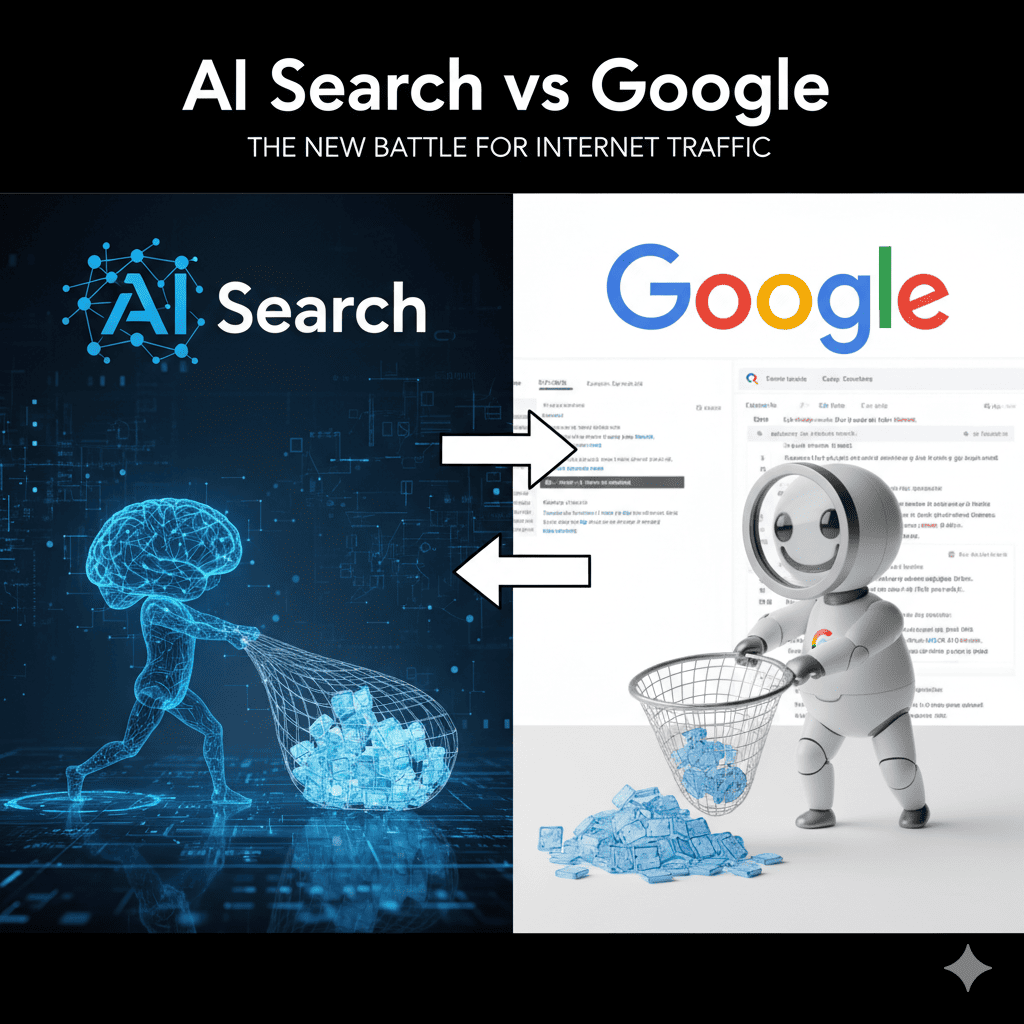
The internet is at a crossroads. For more than two decades, Google has been the undisputed gateway to the world’s information, processing over 8.5 billion searches daily. But something extraordinary is happening right now—something that could fundamentally change how billions of people discover, consume, and interact with online content.
AI Search vs Google has emerged as the defining technological battle of our generation, and the stakes couldn’t be higher. This isn’t just about which search tool you prefer; it’s about the future of internet traffic, the survival of online businesses, and the very nature of how humanity accesses knowledge.
The Revolution We Didn’t See Coming
Remember when Google revolutionized search by replacing cluttered directories with a clean, simple search box? That was 1998. Now, we’re witnessing another paradigm shift—one that’s happening at lightning speed.
Artificial intelligence has crashed the party, and it’s brought a completely different approach to finding information. AI Search vs Google isn’t a fair comparison in the traditional sense because they’re playing entirely different games. Google gives you a map; AI gives you a tour guide.
Traditional search engines, including Google, have always operated on a simple premise: you ask a question, and they show you a ranked list of websites that might have the answer. You do the heavy lifting—clicking links, scanning pages, piecing together information from multiple sources.
AI-powered search engines like ChatGPT, Perplexity, Claude, and Bing’s AI Chat have flipped this model on its head. They don’t just point you toward information; they understand your question, synthesize information from multiple sources, and deliver a comprehensive, conversational answer—all without requiring you to leave the search interface.
This is why the AI Search vs Google debate matters so much. We’re not just comparing features; we’re witnessing the potential obsolescence of a model that has defined the internet for a quarter-century.
How AI Search Is Fundamentally Different
Deep Contextual Understanding
AI search engines don’t just match keywords—they genuinely understand what you’re asking. If you search “best time to visit Paris,” Google shows you articles. An AI search engine understands you’re planning a trip and might ask about your preferences: Do you enjoy crowds? Are you interested in specific events? What’s your budget?
This conversational intelligence represents a quantum leap in search technology. The AI Search vs Google comparison highlights how AI can hold context across an entire conversation, remembering what you asked three questions ago and building on that knowledge.
Synthesized, Direct Answers
Why visit ten websites when AI can read them all and give you the synthesized answer? AI search aggregates information from multiple authoritative sources, cross-references facts, identifies patterns, and presents a cohesive response.
For complex questions like “How do quantum computers differ from classical computers, and what are the practical applications available today?”—AI search doesn’t just link to articles. It explains the core differences, provides examples, and discusses real-world applications in a single, coherent response.
Natural, Conversational Interactions
Traditional search requires you to think like a search engine—choosing the right keywords, refining queries, and thinking in “search-speak.” AI search lets you ask questions the way you’d ask a knowledgeable friend.
You can say: “I’m learning Python and struggling with decorators. Can you explain them simply?” Then follow up with: “Show me a practical example,” and “What are the common mistakes beginners make?”
This fluid, natural interaction is why AI Search vs Google isn’t just about better results—it’s about a fundamentally more human way of finding information.
Personalized and Adaptive
AI search learns from your interactions, adapting its responses to your level of expertise, communication style, and preferences. It remembers that you’re a visual learner or that you prefer technical details over simplified explanations.
Google personalizes results based on your history, but AI search personalizes the answer itself—adjusting tone, depth, and format to suit your needs.
The Traffic Earthquake: What AI Search Means for the Internet
The AI Search vs Google competition has sent shockwaves through the digital ecosystem. Content creators, marketers, publishers, and businesses are waking up to a sobering reality: the rules have changed overnight.
The Zero-Click Apocalypse
Here’s the uncomfortable truth: when AI provides complete, satisfactory answers without requiring users to click through to websites, organic traffic plummets.
Publishers who have spent years building their traffic through SEO are suddenly facing an existential threat. If users get their information without ever visiting your site, how do you generate ad revenue? How do you build an audience? How do you even measure success?
Recent studies suggest that AI-powered search features could reduce click-through rates by 25-40% for informational queries. That’s not a slight dip—that’s a potential catastrophe for content-dependent businesses.
The Death of Page One Rankings?
In the traditional Google model, ranking on page one meant visibility, traffic, and revenue. In the AI search era, your meticulously optimized content might be summarized, paraphrased, or synthesized with dozens of other sources—without users ever knowing your site exists.
The AI Search vs Google dynamic is forcing us to confront a radical question: What does “visibility” even mean in an AI-powered search landscape?
Attribution and Citation Challenges
While some AI search tools provide source citations, others don’t. Your research, insights, and expertise might inform an AI’s response, but will you receive credit? Will users visit your site? Will you benefit from the value you’ve created?
This attribution gap represents one of the most contentious aspects of the AI Search vs Google debate, with publishers and creators demanding fair recognition and compensation for their content.
Quality Content vs. AI-Friendly Content
There’s a new tension emerging: Do you write for humans or for AI? Content that ranks well in Google might not be the content that AI systems cite or reference. SEO is evolving into AIO (Artificial Intelligence Optimization), and the strategies are still being figured out in real-time.
Google Fights Back: The Tech Giant’s Response
Google didn’t build a trillion-dollar empire by ignoring disruption. The company understands that AI Search vs Google isn’t just a competitive threat—it’s an existential one.
Google AI Overviews: The Hybrid Approach
Google has rolled out AI Overviews (formerly Search Generative Experience or SGE) that provide AI-generated summaries directly in search results. It’s Google’s attempt to offer the best of both worlds: AI-powered answers and traditional search results.
But this hybrid approach reveals Google’s fundamental dilemma: Every AI answer that satisfies a user without a click is revenue Google doesn’t earn from ads on clicked websites.
Gemini Integration: Google’s AI Powerhouse
Google’s Gemini AI is being woven throughout its product ecosystem, bringing sophisticated conversational AI capabilities to search, workspace tools, and more. The company is betting that its vast data advantages and integration across platforms will help it win the AI Search vs Google arms race.
The Advertising Dilemma
Here’s Google’s catch-22: AI search undermines the very business model that made Google dominant. Google’s revenue comes primarily from ads shown alongside search results and on websites users visit. If AI answers eliminate the need to visit websites, the entire advertising ecosystem collapses.
This is why AI Search vs Google isn’t just a technology battle—it’s a business model battle.
The Winners and Losers in the New Search Era
Who Benefits from AI Search?
Users seeking quick answers are the immediate winners. Students researching topics, professionals solving problems, and curious minds exploring new subjects all benefit from faster, more comprehensive answers.
Large language model companies like OpenAI, Anthropic, and Perplexity are capturing market share and attention once exclusively owned by Google.
Brands with strong recognition can maintain traffic through direct visits, social media, and brand searches, partially insulating themselves from the zero-click problem.
Who Loses in This Shift?
Small and medium publishers who depend on organic search traffic face the most significant threat. Without alternative traffic sources, many may struggle to survive.
Affiliate marketers and comparison sites that monetize through clicks are particularly vulnerable as AI can synthesize comparisons without users visiting these intermediary sites.
Niche content creators who’ve built audiences through search visibility may find their carefully crafted content absorbed into AI responses without proper attribution or traffic.
Coexistence or Conquest? The Future of AI Search vs Google
Despite the dramatic headlines, the reality is more nuanced. AI Search vs Google may not be a winner-take-all scenario.
Google’s Enduring Strengths
Local Search: Try asking an AI for “restaurants near me open now.” Google Maps, reviews, and real-time information give traditional search an unbeatable edge for local queries.
Shopping: Product search, price comparisons, and merchant reviews are deeply integrated into Google’s ecosystem in ways AI search hasn’t replicated.
Visual Search: Finding images, exploring visual content, and reverse image searches remain Google’s domain.
Current Events: Google News and real-time search results for breaking stories provide freshness that AI models, trained on historical data, struggle to match.
Discovery: Sometimes we don’t know exactly what we’re looking for. Traditional search facilitates exploration and discovery in ways conversational AI hasn’t fully captured.
AI Search’s Killer Applications
Complex Research: Multi-step reasoning, synthesizing information across domains, and explaining difficult concepts are where AI search truly shines.
Learning and Education: Interactive tutoring, personalized explanations, and adaptive teaching make AI search exceptional for learning.
Creative Work: Brainstorming, ideation, drafting, and creative exploration benefit from AI’s conversational flexibility.
Professional Problem-Solving: From debugging code to strategizing business challenges, AI search excels at nuanced, context-rich queries.
Adapting to the New Reality: Strategies for Survival and Success
The AI Search vs Google landscape demands new strategies. Here’s how to thrive in this evolving ecosystem:
1. Create “AI-Citation-Worthy” Content
Focus on producing authoritative, comprehensive, well-structured content that AI systems will want to cite as sources. This means:
- Deep research and original insights
- Clear structure with headers and lists
- Authoritative citations and data
- Expert authorship with credentials
2. Build Direct Relationships
Don’t depend solely on search traffic. Build direct connections through:
- Email newsletters
- Social media communities
- Exclusive membership content
- Brand loyalty and repeat visits
3. Optimize for Featured Snippets and Structured Data
Make your content AI-friendly by:
- Using schema markup
- Creating clear, direct answers to common questions
- Structuring content for easy extraction
- Implementing FAQ sections
4. Focus on E-E-A-T
Google’s emphasis on Experience, Expertise, Authoritativeness, and Trustworthiness is even more critical in the AI era. Demonstrate your credentials, showcase real experience, and build authoritative content that stands out.
5. Diversify Traffic Sources
Never put all your eggs in one basket:
- Social media platforms
- YouTube and video content
- Podcasts and audio
- Partnerships and collaborations
- Paid advertising when appropriate
6. Create “Destination Content”
Build content experiences that users actively want to visit—interactive tools, calculators, unique visuals, original research, community discussions, and exclusive resources that AI can’t replicate.
7. Embrace AI as a Tool, Not Just a Competitor
Use AI to enhance your content creation, research, optimization, and distribution. The smartest approach to AI Search vs Google is leveraging both platforms strategically.
The Bigger Picture: How We’ll Search Tomorrow
The battle between AI Search vs Google transcends technology—it’s about how humanity will access and process information in the coming decades.
The Hybrid Future
Most likely, we’ll see a hybrid ecosystem where:
- Traditional search handles transactional, local, and visual queries
- AI search manages complex, conversational, and research-heavy questions
- Users seamlessly switch between modalities based on their needs
New Search Behaviors
User behavior is already evolving:
- Longer, more conversational queries
- Higher expectations for immediate, complete answers
- Reduced patience for clicking through multiple sources
- Increased trust in AI-synthesized information
The Ethics and Accuracy Question
As AI search becomes mainstream, critical questions emerge:
- How do we ensure AI-generated answers are accurate?
- What happens when AI “hallucinates” false information?
- How do we hold AI systems accountable?
- What’s the role of human verification?
The AI Search vs Google debate must include these ethical considerations, not just technical capabilities.
Your Move: Navigating the Transition
Change is never comfortable, but it’s inevitable. The digital landscape you knew is transforming before your eyes. The question isn’t whether AI Search vs Google will reshape internet traffic—it’s how quickly it will happen and whether you’ll be prepared.
Start experimenting with AI search tools. Understand how they work, what they prioritize, and how they present information. Simultaneously, don’t abandon proven SEO strategies that continue delivering results on Google.
The winners in this new era won’t be those who choose one platform over another. They’ll be the adaptable strategists who understand both ecosystems, create genuinely valuable content, build direct audience relationships, and remain flexible as the landscape continues evolving.
The AI Search vs Google revolution is here. The internet’s power structure is shifting. Your content strategy needs to evolve.
How are you adapting? Are you preparing for the AI-powered search future, or are you still optimizing for yesterday’s algorithms? Share your thoughts, experiences, and strategies—the conversation about our digital future needs your voice.
The search wars have begun. Which side of history will you be on?
Also read this:
The Glow-Up Trend: How AI Is Redefining Beauty Standards in 2025
5 Websites That Pay You to Use AI (Earn Money Online in 2025)
Best Free AI Tools to Build a 6-Figure Brand in 2025 (No Budget Required)