
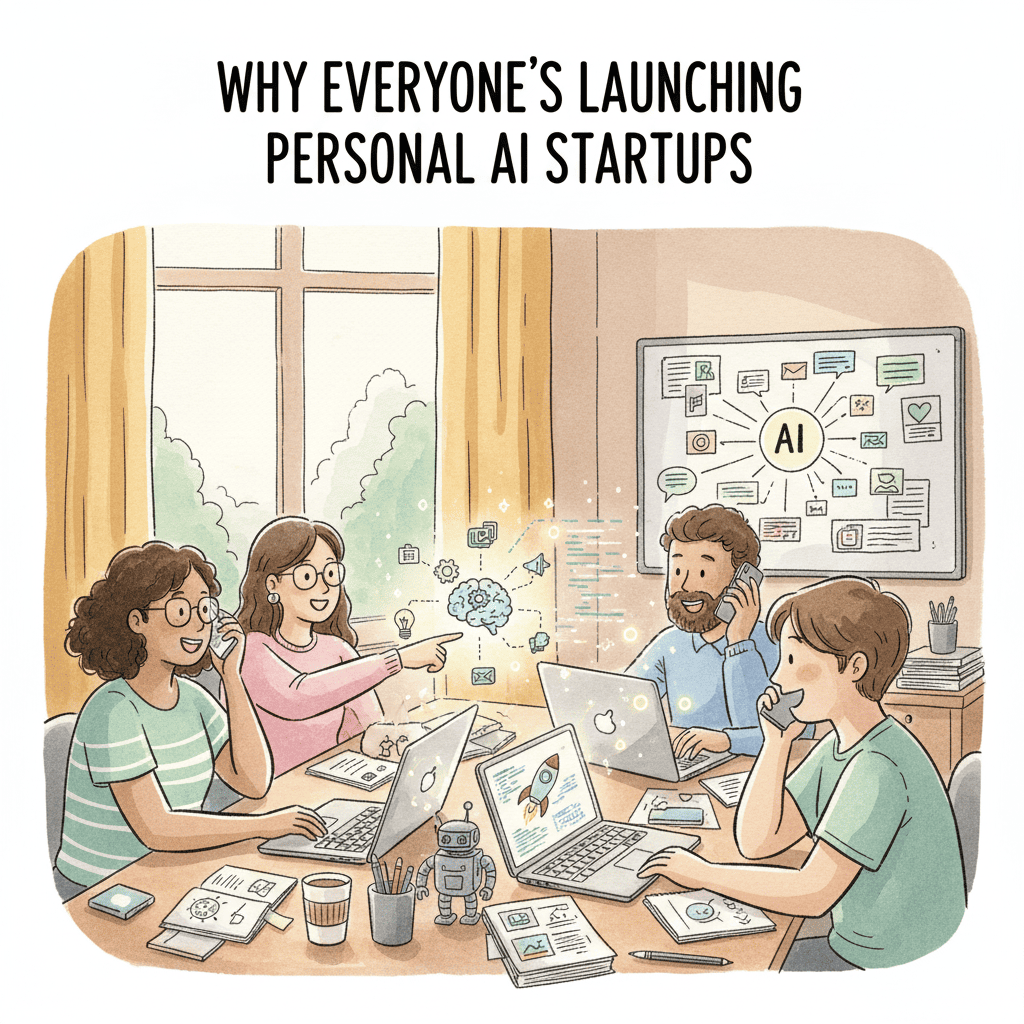
Open Twitter—sorry, X—and you’ll see it everywhere. Developers, entrepreneurs, even people who’ve never coded before are announcing their new AI ventures. The wave of Personal AI Startups isn’t just a trend; it’s a fundamental shift in how technology businesses are being built.
But here’s what nobody’s talking about: why is this happening now? What’s different about 2025 that’s making it possible for seemingly everyone to launch an AI company? And more importantly, why are so many of these Personal AI Startups actually succeeding when conventional wisdom says most startups should fail?
Let me break down what’s really going on beneath the surface of this AI gold rush.
The Barrier to Entry Just Collapsed
Remember when starting a tech company required a team of engineers, months of development, and hundreds of thousands in funding? That world is gone.
The explosion of Personal AI Startups is happening because the traditional barriers have been absolutely demolished. Here’s what changed practically overnight.
APIs Changed Everything
OpenAI’s API, Claude’s API, Google’s Gemini API—these aren’t just tools for existing companies. They’re complete AI engines that anyone can plug into. You don’t need to train models. You don’t need massive computing power. You don’t even need to understand the underlying mathematics.
You pay per API call. That’s it.
This is like if building a car suddenly only required you to design the exterior and interior, while someone else provided the engine, transmission, and all the complex mechanics. Except it’s better—because you can swap engines instantly if you find a better one.
A solo founder can now build in weeks what would have required a team of AI researchers and millions in funding just three years ago.
No-Code and Low-Code Platforms
The second barrier that fell was the need to be a programmer. Platforms like Bubble, Webflow, and Zapier let people build functional products without writing code.
Combine these with AI APIs and you’ve got a complete business infrastructure accessible to anyone with an idea and willingness to learn.
Someone who learned to code six months ago can now build and launch a functional AI product. The skill gap has compressed from years to months, or even weeks for simple applications.
Cloud Infrastructure Is Dirt Cheap
AWS, Google Cloud, and Vercel offer free tiers that can handle thousands of users. Scaling only costs money when you’re actually making money.
You can launch a Personal AI Startup with less than $100 in initial investment. Compare that to traditional tech startups that needed $50,000-$100,000 just to get to MVP stage.
The financial risk has dropped by 99%. That’s not hyperbole—it’s mathematics.
Why Personal AI Startups Are Actually Working
Low barriers explain why people are launching. But they don’t explain why so many are succeeding. That requires understanding what’s different about the AI market itself.
The Market Is Absolutely Massive
AI isn’t a niche. It’s not even a big market. It’s every market simultaneously.
Every industry, every profession, every task that involves information processing is being reimagined with AI. That creates millions of micro-opportunities—specific problems that large companies won’t bother solving but that represent viable businesses for solo founders or small teams.
A Personal AI Startup doesn’t need to compete with OpenAI or Google. It needs to solve one specific problem really well for a specific audience. That’s completely achievable.
Speed Beats Size Right Now
Large companies move slowly. They have bureaucracy, legal reviews, brand concerns, and established products that might cannibalize.
Personal AI Startups move fast. A solo founder can identify a need, build a solution, and have paying customers in a matter of weeks. They can pivot instantly if something isn’t working.
In a rapidly evolving space like AI, speed is a massive competitive advantage. The person who ships first wins, even if their product is imperfect.
Customers Are Desperately Seeking Solutions
Here’s what’s fascinating: demand is outpacing supply right now. Businesses and individuals know AI can help them, but they don’t know how to implement it.
They’re actively searching for tools that solve their specific problems. They’re willing to pay immediately because the value is obvious. They’re forgiving of bugs and rough edges because they need solutions now.
This is the opposite of most markets, where you have to create demand through marketing. In AI, demand already exists—you just need to match it with a solution.
The Minimum Viable Product Is Actually Minimal
You can launch a Personal AI Startup with one core feature. Not five features. Not ten. One.
“AI that summarizes meeting notes.” That’s a business. “AI that generates social media captions from product photos.” That’s a business. “AI that converts voice memos to structured task lists.” That’s a business.
Each of these can be built in days or weeks. Each solves a real problem. Each has people willing to pay.
The Psychology Behind the Wave
Let’s dig deeper into why the wave of Personal AI Startups is so compelling to founders. It’s not just about business opportunity—there’s fascinating psychology at play.
FOMO Is Real and Justified
The fear of missing out on AI isn’t irrational. This actually is a once-in-a-generation technology shift, similar to the internet in the 1990s or mobile in the late 2000s.
People who launched web startups in 1998 caught a wave that created generational wealth. Same with mobile app developers in 2009. The founders of Personal AI Startups in 2025 might be looking at similar opportunities.
The difference is that this wave is more accessible than previous ones. You didn’t need to be a computer science major to see the opportunity, but you needed significant technical skills. Now? The barriers are so low that anyone can participate.
The Democratization Feels Empowering
There’s something psychologically powerful about leveling the playing field. For decades, tech startups were the domain of Silicon Valley engineers and venture-backed founders.
Now, a designer in Austin, a marketer in Toronto, or a teacher in Mumbai can build and launch an AI product. The gatekeepers are gone. The prerequisites have vanished.
This democratization creates a sense of possibility that’s intoxicating. “If they can do it, why can’t I?” isn’t arrogance—it’s accurate assessment.
Immediate Feedback Loops
Unlike traditional startups where you might spend months building before knowing if anyone cares, Personal AI Startups can get customer feedback in days.
Tweet about your idea. Build a simple landing page. Launch on Product Hunt. You know within 72 hours if people care.
This rapid feedback—positive or negative—is addictive. It makes entrepreneurship feel less like a massive leap into the unknown and more like a series of small, manageable experiments.
The Creator Economy Mindset
A generation raised on YouTube, Substack, and Patreon has learned that individuals can build sustainable businesses without corporate backing.
Personal AI Startups are the natural evolution of the creator economy. Instead of creating content, you’re creating tools. Instead of building an audience first, you’re solving problems directly.
The mindset of “I can build something valuable and people will pay for it” is already established. AI just made the “building” part dramatically easier.
The Actual Numbers Behind Personal AI Startups
Let’s get concrete. What does success actually look like for these ventures?
The Micro-SaaS Model
Most successful Personal AI Startups follow the micro-SaaS model: small monthly recurring revenue from a focused tool.
Typical pricing: $10-$50 per month per user. Target: 100-1,000 paying customers.
Do the math: 200 customers at $20/month = $4,000 monthly recurring revenue = $48,000 annually. That’s a life-changing side income or modest full-time income for many people globally.
Get to 500 customers and you’re at $120,000 annually. That’s a solid full-time living as a solo founder with minimal overhead.
The Costs Are Incredibly Low
Monthly expenses for a typical Personal AI Startup:
- API costs: $100-$500 (scales with usage)
- Hosting: $20-$100
- Tools and services: $50-$200
- Total: $170-$800 per month
Even at the high end, you’re profitable with just 40 customers at $20/month. Most traditional businesses need far more revenue to achieve profitability.
The Time Investment Is Reasonable
Many successful Personal AI Startups were built by people working nights and weekends around full-time jobs.
Initial build: 2-8 weeks of part-time work Ongoing maintenance: 5-15 hours per week Customer support: 2-5 hours per week
This is manageable. You’re not sacrificing your entire life. You’re dedicating focused time to building something that could replace or supplement your income.
The Success Rate Is Higher Than Normal
Traditional startup failure rates are brutal: 90% fail within five years. But Personal AI Startups seem to be bucking this trend.
Why? Lower costs mean less pressure. Faster iteration means quicker product-market fit. Existing demand means easier customer acquisition.
Anecdotally, founders who ship consistently and listen to users have 30-40% success rates at building sustainable income. That’s remarkable compared to traditional startup statistics.
The Types of Personal AI Startups That Are Working
Not all AI products are created equal. Let’s look at what’s actually succeeding.
Workflow Automation Tools
These solve specific, annoying tasks that people do repeatedly. AI that extracts data from invoices. AI that generates weekly reports from raw data. AI that converts meeting notes to action items.
They’re not sexy. But they save time, and time is money. Businesses pay happily for these solutions.
Examples making money right now: AI expense report generators, contract analysis tools, email sorting and summarization tools.
Content Generation Assistants
Not generic “write me a blog post” tools—those are commoditized. But specific content tools for specific niches.
AI that writes product descriptions for e-commerce. AI that generates real estate listings. AI that creates educational worksheets for teachers. AI that writes job descriptions matching company tone.
The key is specificity. The more narrowly focused, the more valuable to that specific audience.
Personalized Learning and Coaching
AI tutors for specific subjects. AI fitness coaches that adapt to your progress. AI language learning companions. AI coding mentors.
The personalization is key. Generic advice is free online. Advice tailored to your specific situation, goals, and progress? That’s worth paying for.
Analysis and Insights Tools
AI that analyzes your website data and explains what actions to take. AI that reviews your social media and suggests improvements. AI that examines your business finances and identifies opportunities.
People have data. They don’t have time or expertise to analyze it. Personal AI Startups that bridge this gap are printing money.
Communication Enhancers
AI that helps non-native English speakers write professional emails. AI that converts technical jargon to plain language. AI that adapts your writing tone for different audiences.
Communication is universal, making these tools broadly applicable while still solving real problems.
The Challenges Nobody Talks About
The hype around Personal AI Startups is real, but let’s be honest about the challenges.
Differentiation Is Getting Harder
When everyone can build an AI tool quickly, standing out becomes the challenge. You’re not competing against Google—you’re competing against 10,000 other solo founders with similar ideas.
The solution isn’t better AI—everyone has access to the same APIs. It’s better understanding of your specific audience, better marketing, better UX, or faster iteration.
Customer Acquisition Isn’t Automatic
Building the product is the easy part. Finding customers who will pay is hard. This has always been true, but many new founders assume “build it and they will come.”
They won’t. You need distribution strategy. That might be SEO, paid ads, partnerships, content marketing, or community building. The product is 20% of success—distribution is 80%.
Sustainability Requires Iteration
Your first version will be wrong about something. Maybe it’s pricing, maybe it’s features, maybe it’s target audience.
The successful Personal AI Startups are run by founders who constantly improve based on user feedback. The failed ones are run by people who build once and expect it to work forever.
The Competitive Moat Question
What prevents someone from copying your product in two weeks? Often, nothing technical.
Your moat is: brand recognition, customer relationships, network effects, proprietary data, superior UX, or speed of iteration. These take time to build but they’re the difference between a weekend project and a sustainable business.
API Dependency Is Risk
When your entire business depends on OpenAI or Anthropic’s API, you’re vulnerable. API prices can increase. Terms can change. Services can be deprecated.
Smart Personal AI Startups diversify: they build on multiple APIs, they add value beyond just API calls, they own the customer relationship, and they create switching costs that make customers sticky.
What the Next Wave Looks Like
The current explosion of Personal AI Startups is just the beginning. Here’s what’s coming next.
Specialization Will Deepen
The generic “AI assistant” phase is ending. The winning products will be hyper-focused on specific industries, professions, or use cases.
Not “AI for marketing.” Instead: “AI for cold email follow-up in B2B SaaS sales.” That level of specificity will command premium pricing and create loyal customers.
Multi-Agent Systems
The next generation of Personal AI Startups won’t be single AI models. They’ll be multiple AI agents working together on complex workflows.
One agent gathers information. Another analyzes it. A third generates recommendations. A fourth implements actions. This orchestration creates value that’s harder to replicate.
AI + Human Hybrid Services
Pure AI solutions have limitations. The emerging winners combine AI efficiency with human oversight or expertise.
“AI does the first draft, human expert reviews and refines.” This creates better outcomes than either could achieve alone and justifies higher pricing.
Local and Privacy-Focused AI
As AI becomes ubiquitous, privacy concerns will grow. Personal AI Startups that run locally on user devices or offer guaranteed data privacy will command premium markets.
Especially in healthcare, legal, and financial services where confidentiality is critical.
Vertical Integration
The current wave is mostly wrapper apps—thin interfaces over existing AI APIs. The next wave will own more of the stack.
This might mean fine-tuned models for specific use cases, proprietary data sets, or custom AI architectures. Higher barriers to entry, but also higher defensibility.
Should You Launch a Personal AI Startup?
Here’s the honest assessment: should you join the wave?
You Should If…
You’ve identified a specific problem you can solve. Not “AI is cool, I should build something.” But “I know accountants spend hours on X, and AI could automate it.”
You’re willing to iterate quickly. Your first version will be wrong. Can you ship, get feedback, and improve weekly?
You have some technical comfort. You don’t need to be an engineer, but you need willingness to learn tools and troubleshoot issues.
You can commit 10-20 hours weekly for 3-6 months. This isn’t a get-rich-quick scheme. It requires sustained effort.
You’re okay with uncertainty. The market is moving fast. What works today might not work tomorrow. Flexibility and resilience matter.
You Shouldn’t If…
You’re just chasing hype. Building a business because everyone else is rarely works. You need genuine interest and commitment.
You expect passive income immediately. Active effort is required, especially early on. Even “passive” income requires ongoing maintenance and improvement.
You’re unwilling to do marketing. The best product that nobody knows about makes $0. Distribution is as important as development.
You need guaranteed income now. This is risky. Don’t quit your job or bet money you can’t afford to lose.
You’re not willing to pivot. Stubbornly pursuing a failing idea is the path to wasted time. Successful founders pivot ruthlessly based on feedback.
The Practical Steps to Launch
If you’ve decided to join the wave of Personal AI Startups, here’s your roadmap.
Month 1: Validation and Planning
Week 1-2: Identify a specific problem worth solving. Talk to potential users. Confirm they’ll actually pay for a solution.
Week 3-4: Research existing solutions. Identify gaps you can fill. Plan your unique angle.
Don’t skip validation. Most failures happen because people build something nobody wants.
Month 2: Build Your MVP
Week 5-6: Learn necessary tools. Set up your development environment. Build the core functionality—just one feature that solves the main problem.
Week 7-8: Create a simple landing page. Set up payment processing. Build the absolute minimum to get users started.
Resist the urge to add features. Ship something that works, not something perfect.
Month 3: Launch and Learn
Week 9: Launch on Product Hunt, Twitter, and relevant communities. Get initial users.
Week 10-11: Frantically gather feedback. What do people love? What’s confusing? What’s missing?
Week 12: Implement the most important improvements based on feedback.
Month 4-6: Iterate and Grow
Continue the cycle: ship improvements, gather feedback, repeat.
Focus on making existing users successful. Happy users become your best marketers.
Experiment with customer acquisition channels. Find what works for your specific product.
Gradually raise prices as you add value and build reputation.
The Mindset That Separates Success from Failure
I’ve watched hundreds of Personal AI Startups launch. The successful founders share common mindsets.
Bias Toward Action
They ship imperfect products. They test assumptions quickly. They’d rather be wrong fast than perfect slowly.
Overthinking kills momentum. Successful founders build, launch, and learn in rapid cycles.
Customer Obsession
They don’t fall in love with their product—they fall in love with their customers’ problems.
If users aren’t using a feature, they remove it. If users want something else, they build it. Ego doesn’t cloud judgment.
Transparent Communication
They share their journey publicly. This builds community, creates accountability, and attracts early adopters who want to be part of something.
Regular updates on progress, challenges, and learnings create connection with potential customers.
Long-Term Thinking
They understand this is a marathon, not a sprint. Overnight success is rare. Sustainable businesses are built month by month.
They celebrate small wins: first user, first dollar, first week of profitability. These milestones matter.
Resilient Optimism
They’re realistic about challenges while remaining optimistic about outcomes. They know setbacks will happen but believe they can overcome them.
This balance prevents both naive overconfidence and paralyzing pessimism.
The Meta Question: Why Now?
Let’s zoom all the way out. Why is the wave of Personal AI Startups happening in 2025 specifically?
It’s the convergence of multiple factors that rarely align:
Accessible technology: APIs make AI simple to implement.
Low costs: Cloud infrastructure and tooling have never been cheaper.
Massive demand: Every industry wants AI solutions.
Democratic distribution: Internet access means global markets for everyone.
Entrepreneurial culture: A generation raised on the possibility of individual success.
Economic uncertainty: Traditional employment feels less stable, making entrepreneurship more appealing.
Proof of concept: Enough successful examples exist to show it’s possible.
This confluence creates a perfect storm of opportunity. It won’t last forever—windows like this close as markets mature and competition intensifies.
But right now, in this moment, the opportunity is extraordinary.
Final Thoughts: Your Decision
The wave of Personal AI Startups is real. The opportunities are legitimate. The barriers are genuinely lower than they’ve ever been.
But opportunity doesn’t equal guarantee. Most Personal AI Startups will fail to gain meaningful traction. Many will shut down within a year. Some founders will lose money and time.
The question isn’t whether the opportunity exists—it clearly does. The question is whether you’re the right person to pursue it.
Are you solving a real problem? Are you willing to commit the time? Can you handle the uncertainty? Will you iterate based on feedback? Do you have the resilience to push through inevitable setbacks?
If your answers are yes, then this might be your moment.
The barriers are low. The market is huge. The timing is right. What happens next is up to you.
Will you be one of the thousands launching a Personal AI Startup? Or will you watch from the sidelines while others build the future?
Either choice is valid. But make it consciously, not by default.
The wave is here. The only question is whether you’re ready to ride it.
Also read this:
How to Make $100/Day Using ChatGPT (Legally)