
In our time-starved world where everyone claims they’re too busy to exercise, a scientifically-backed fitness routine has taken social media by storm. The 7-Minute Workout has exploded across TikTok, Instagram, and YouTube, racking up millions of views and transforming how people approach fitness. This high-intensity circuit training program promises maximum results in minimal time, and the viral sensation isn’t just hype—it’s backed by legitimate exercise science that’s converting skeptics into believers.
What makes this workout so compelling isn’t just its brevity. The 7-Minute Workout represents a fundamental shift in how we think about fitness, proving that you don’t need expensive gym memberships, complicated equipment, or hours of free time to build strength, improve cardiovascular health, and transform your body. With nothing more than a chair, a wall, and your own bodyweight, you can complete a scientifically-designed workout that delivers results comparable to much longer traditional exercise sessions.
This comprehensive guide explores everything you need to know about the viral 7-Minute Workout phenomenon—from the science behind its effectiveness to step-by-step instructions for every exercise, modifications for different fitness levels, and strategies for incorporating this revolutionary routine into your lifestyle. Whether you’re a fitness novice intimidated by conventional workouts or an experienced athlete seeking efficient training options, this guide will show you why millions are embracing this time-efficient approach to health and fitness.
1. The Science Behind the 7-Minute Workout Revolution
The 7-Minute Workout isn’t a random collection of exercises dreamed up by social media influencers. It’s a carefully designed high-intensity circuit training (HICT) program developed by exercise scientists and published in the American College of Sports Medicine’s Health & Fitness Journal. This scientific foundation separates the legitimate 7-Minute Workout from countless fitness fads promising unrealistic results.
High-Intensity Interval Training Principles
The workout leverages high-intensity interval training (HIIT) principles, alternating between intense bursts of activity and brief recovery periods. This approach triggers physiological adaptations that improve both aerobic and anaerobic fitness simultaneously—something traditional steady-state cardio struggles to achieve efficiently.
During the intense 30-second work intervals, your body operates anaerobically, burning through immediate energy stores and creating metabolic demands that continue long after the workout ends. This “afterburn effect,” scientifically known as excess post-exercise oxygen consumption (EPOC), means your body continues burning calories at elevated rates for hours following your workout.
The brief 10-second rest periods between exercises keep your heart rate elevated throughout the circuit, providing cardiovascular benefits typically associated with much longer endurance training sessions. This combination of strength and cardio elements in a single efficient package explains why the 7-Minute Workout delivers such impressive results.
Metabolic and Cardiovascular Benefits
Research demonstrates that HIIT protocols like the 7-Minute Workout improve VO2 max (the body’s maximum oxygen utilization capacity) more effectively than moderate-intensity continuous training, despite requiring significantly less time. These cardiovascular improvements translate to better heart health, increased endurance, and reduced risk of cardiovascular disease.
The metabolic benefits extend beyond immediate calorie burn. Regular HIIT training improves insulin sensitivity, enhances fat oxidation, and can help regulate blood sugar levels. These metabolic adaptations make the 7-Minute Workout particularly valuable for individuals concerned about metabolic health, weight management, or diabetes prevention.
Muscle Activation and Strength Development
While seven minutes might seem insufficient for strength gains, the workout’s design ensures comprehensive muscle activation across all major muscle groups. Each exercise targets specific areas—legs, core, chest, back, and arms—creating a balanced full-body stimulus that promotes functional strength development.
The bodyweight resistance, combined with the high-intensity tempo, creates sufficient mechanical tension and metabolic stress to stimulate muscle protein synthesis. While you won’t build the same muscle mass as dedicated strength training programs, the 7-Minute Workout provides enough stimulus to maintain and gradually improve muscular strength and endurance.
Time-Efficiency and Adherence
Perhaps the most important scientific consideration is adherence—people only benefit from exercise they actually do consistently. Traditional workout recommendations of 30-60 minutes often prove unrealistic for busy individuals, leading to abandoned fitness plans and yo-yo patterns of starting and stopping.
The 7-Minute Workout removes time as a barrier, making “too busy” no longer a valid excuse. This accessibility dramatically improves adherence rates, and consistent short workouts ultimately deliver better results than sporadic longer sessions. The psychological win of completing a full workout before most people finish their morning coffee creates positive reinforcement that builds lasting exercise habits.
2. The 12 Essential Exercises: Complete Movement Breakdown
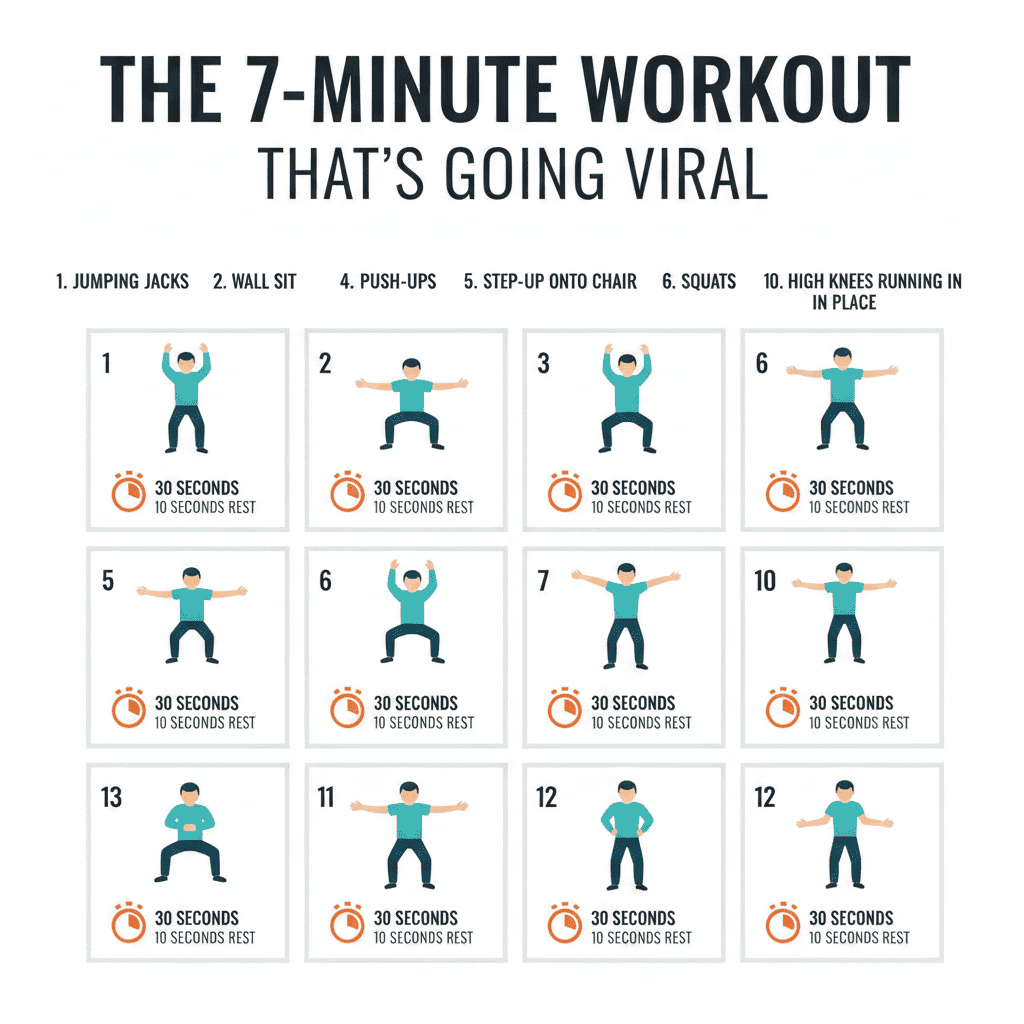
The original 7-Minute Workout consists of 12 exercises performed for 30 seconds each with 10-second transitions between movements. This specific sequence was carefully designed to alternate between upper body, lower body, and core exercises while rotating between opposing muscle groups, allowing brief recovery while maintaining overall intensity.
Exercise Sequence and Strategic Ordering
The exercise order isn’t arbitrary—it follows biomechanical principles that maximize efficiency while managing fatigue. By alternating between upper and lower body movements, you allow muscle groups brief recovery periods without stopping the workout entirely. This strategic sequencing enables sustained high intensity that would be impossible if similar exercises were grouped together.
1. Jumping Jacks (Total Body Warm-Up)
Begin standing with feet together and arms at your sides. Jump while simultaneously spreading your legs shoulder-width apart and raising your arms overhead. Immediately reverse the motion, jumping back to the starting position. This classic cardio move elevates your heart rate, warms up your joints, and prepares your body for the more demanding exercises ahead.
2. Wall Sit (Lower Body Strength)
Position your back flat against a wall and lower into a sitting position with thighs parallel to the ground, knees at 90-degree angles directly above ankles. Hold this isometric position for the full 30 seconds. Wall sits build incredible leg strength and endurance, particularly targeting your quadriceps, glutes, and core stabilizers.
3. Push-Ups (Upper Body and Core)
Start in a plank position with hands slightly wider than shoulder-width. Lower your body until your chest nearly touches the floor, keeping your core tight and body in a straight line. Push back up to the starting position. This fundamental exercise builds chest, shoulder, and tricep strength while engaging your entire core for stability.
4. Abdominal Crunches (Core Strength)
Lie on your back with knees bent and feet flat on the floor. Place hands behind your head without pulling on your neck. Engage your abs to lift your shoulder blades off the floor, exhaling as you crunch upward. Lower back down with control. This targets your rectus abdominis—the visible “six-pack” muscles.
5. Step-Ups onto Chair (Lower Body Power)
Stand facing a sturdy chair or bench. Step up with your right foot, driving through your heel to lift your body onto the chair. Bring your left foot up to meet the right, then step back down with control. Alternate leading legs throughout the 30 seconds. This functional movement builds leg strength and cardiovascular endurance simultaneously.
6. Squats (Lower Body Compound Movement)
Stand with feet shoulder-width apart, toes slightly turned out. Bend at your hips and knees to lower your body as if sitting back into a chair, keeping your chest up and weight in your heels. Lower until thighs are parallel to the ground (or as low as comfortably possible), then drive through your heels to return to standing. Squats are the king of lower body exercises, engaging virtually every muscle below your waist.
7. Tricep Dips on Chair (Upper Body Strength)
Sit on the edge of a sturdy chair with hands gripping the edge beside your hips. Slide your bottom off the chair, supporting yourself with your arms. Bend your elbows to lower your body toward the floor, keeping elbows pointing straight back. Push back up to straighten your arms. This exercise targets your triceps, shoulders, and chest.
8. Plank (Core Stability)
Position yourself in a forearm plank with elbows directly beneath shoulders, body forming a straight line from head to heels. Engage your core, squeeze your glutes, and hold this position without letting your hips sag or pike upward. The plank builds incredible core strength and full-body stability.
9. High Knees Running in Place (Cardio Intensity)
Run in place while driving your knees up toward your chest as high and fast as possible. Pump your arms vigorously to increase intensity and maintain balance. This explosive cardio movement spikes your heart rate while engaging your hip flexors and core.
10. Lunges (Lower Body Unilateral Strength)
Stand tall and step forward with your right leg, lowering your body until both knees form 90-degree angles. Your back knee should hover just above the floor. Push through your front heel to return to standing, then repeat on the opposite leg. Continue alternating legs throughout the interval. Lunges build single-leg strength, balance, and functional movement patterns.
11. Push-Up with Rotation (Upper Body and Core Integration)
Perform a standard push-up, but at the top of each rep, rotate your torso and extend one arm toward the ceiling, forming a T-shape with your body. Return the hand to the floor and perform another push-up before rotating to the opposite side. This advanced variation adds core rotation and shoulder stability challenges.
12. Side Plank (Oblique Strength)
Lie on your side with your elbow directly beneath your shoulder. Stack your feet and lift your hips off the ground, forming a straight line from head to feet. Hold for 15 seconds on each side (switching at the halfway point). Side planks target your obliques and lateral core stabilizers that regular planks miss.
3. Modifications for Every Fitness Level
One reason the 7-Minute Workout has gone viral is its accessibility across fitness levels. Whether you’re returning to exercise after years of inactivity or you’re an athlete seeking efficient training options, modifications allow everyone to benefit from this program while working at appropriate intensity levels.
Beginner Modifications for Building Confidence
If you’re new to exercise or haven’t been active recently, certain modifications make the 7-Minute Workout more approachable while you build strength and confidence. These adjustments maintain the workout structure and timing while reducing intensity to appropriate levels.
For push-ups, perform them on your knees or against a wall rather than from a full plank position. This reduces the percentage of your bodyweight you’re lifting while allowing you to build the strength needed for standard push-ups. Similarly, if regular squats prove challenging, reduce the depth—partial squats still provide benefits as you develop mobility and strength.
Wall sits can be modified by sitting higher (less knee bend) rather than achieving the full 90-degree angle. Even a 120-degree angle provides strength benefits while you work toward the standard position. For planks, reducing the duration or performing them from your knees maintains core engagement at manageable intensity.
High knees running in place can be modified to marching in place with controlled knee lifts rather than explosive running. This maintains the movement pattern while reducing cardiovascular demands. For tricep dips, keep your feet closer to the chair rather than extended, reducing the percentage of bodyweight your arms must support.
Intermediate Progressions for Continued Challenge
As you grow stronger and more conditioned, the standard 7-Minute Workout might become too easy. Intermediate progressions maintain the time-efficient format while increasing intensity to continue driving adaptations and improvements.
Add a jump at the top of squats, transforming them into explosive squat jumps that dramatically increase cardiovascular demands and power development. For push-ups, elevate your feet on a chair or bench, increasing the load on your upper body and core.
Transform standard lunges into jumping lunges, explosively switching legs mid-air. This plyometric variation builds power while maintaining the single-leg strength benefits. For planks, add arm or leg lifts, creating instability that forces deeper core engagement.
Perform push-up variations at a faster tempo, increasing the number of reps you complete in the 30-second interval. This enhances muscular endurance while maintaining the cardiovascular intensity. Similarly, during wall sits, pulse up and down slightly rather than holding perfectly still, adding dynamic muscle engagement.
Advanced Variations for Athletic Development
Athletes and very fit individuals can transform the 7-Minute Workout into an extremely challenging session through advanced variations that maintain the efficient format while pushing physiological limits.
Add resistance through weighted vests during bodyweight exercises, increasing the load without changing movement patterns. For push-ups, perform them with hands on unstable surfaces like medicine balls, dramatically increasing core stabilization demands.
Transform the workout into a Tabata-style protocol with 40 seconds of work and 20 seconds of rest, increasing total work time while reducing recovery. This simple adjustment significantly elevates cardiovascular demands and metabolic stress.
Perform exercises at maximum speed and intensity rather than controlled tempos. During high knees, drive your knees as explosively as possible. Execute push-ups, squats, and lunges at maximal safe speed, completing significantly more repetitions in each 30-second interval.
Combine multiple exercises into complex movements. For example, perform a squat directly into a jump, landing into a lunge, then exploding back to standing. These complex combinations challenge coordination while maximizing metabolic demands.
4. Common Mistakes and How to Avoid Them
Despite the 7-Minute Workout’s simplicity, several common mistakes undermine results or increase injury risk. Understanding and avoiding these errors ensures you maximize benefits while exercising safely.
Form Degradation Under Fatigue
The workout’s high intensity often leads to form breakdown as fatigue accumulates. Poor form reduces exercise effectiveness and increases injury risk, particularly during movements like push-ups and squats that involve multiple joints.
Prioritize movement quality over quantity throughout the entire workout. If you can’t maintain proper form for the full 30 seconds, reduce your speed or intensity rather than continuing with compromised technique. Performing 10 perfect push-ups delivers better results than 20 sloppy ones that stress your joints incorrectly.
Video yourself performing the 7-Minute Workout periodically to identify form issues you might not notice in the moment. Common problems include knees caving inward during squats, hips sagging during planks, or inadequate depth in lunges. Addressing these issues prevents injury and improves results.
Insufficient Warm-Up and Cool-Down
While the workout itself is brief, proper warm-up and cool-down remain important. Jumping directly into high-intensity exercise from a sedentary state increases injury risk and reduces performance. Although jumping jacks serve as a warm-up within the workout, spending 2-3 minutes with light movement beforehand prepares your body more thoroughly.
Similarly, stopping abruptly after the final exercise can leave you dizzy and doesn’t support recovery. Spend 2-3 minutes walking and performing gentle stretches to gradually return your heart rate to normal while improving flexibility.
Breath Holding During Difficult Exercises
Many people unconsciously hold their breath during challenging exercises like wall sits, planks, or push-ups. This breath-holding spikes blood pressure and reduces oxygen delivery to working muscles, impairing performance and creating unnecessary cardiovascular stress.
Focus on breathing continuously throughout every exercise, even when it feels difficult. During wall sits and planks, establish a breathing rhythm—inhale for a count, exhale for a count—to ensure steady oxygen flow. During dynamic movements, exhale during the exertion phase (pushing up during push-ups, standing during squats).
Inadequate Recovery Between Workouts
The 7-Minute Workout’s efficiency tempts some people to perform it multiple times daily or every single day without rest. While seven minutes feels brief, the high intensity creates significant physiological stress that requires recovery time.
Most people should perform the workout 3-4 times per week with at least one rest day between sessions. This frequency allows adequate recovery while providing sufficient stimulus for adaptation. More isn’t always better—proper recovery is when your body actually adapts and improves.
Neglecting Progressive Overload
Some practitioners perform the identical 7-Minute Workout at the same intensity for months or years, wondering why their results plateau. Like any exercise program, continuous improvement requires progressive overload—gradually increasing demands over time.
Implement progression through various methods: increase the difficulty of exercise variations, complete more repetitions during each interval, reduce rest periods slightly, or add a second circuit after completing the first. These progressive challenges ensure continued adaptation rather than stagnation.
5. Incorporating the Workout Into Your Lifestyle
The viral success of the 7-Minute Workout stems partly from its compatibility with modern lifestyles. However, maximizing results requires strategic integration rather than random implementation whenever you happen to remember.
Optimal Timing Strategies
Morning workouts offer several advantages: they’re completed before daily responsibilities create obstacles, they boost metabolism and energy levels throughout the day, and they establish positive momentum. Many adherents of the 7-Minute Workout perform it immediately after waking, even before coffee, making it an automatic morning ritual.
Lunchtime workouts provide a midday energy boost and mental clarity reset, particularly valuable for people experiencing afternoon energy crashes. The brief nature of the 7-Minute Workout allows completion during lunch breaks without requiring showers or extensive time away from work.
Evening workouts help release accumulated stress and tension from the workday. However, high-intensity exercise can interfere with sleep for some individuals, so if you notice sleep disruption, shift your workout earlier in the day.
Creating Environmental Cues and Habit Stacking
Habit formation research emphasizes the importance of environmental cues and habit stacking—linking new behaviors to existing routines. Place your exercise mat in a visible location where you’ll encounter it regularly. This environmental cue serves as a reminder and reduces friction in starting your workout.
Stack the 7-Minute Workout immediately after an established habit: right after brushing your teeth, immediately upon ending your morning coffee, or as the first activity when arriving home from work. These connections leverage existing neural pathways, making the new habit easier to establish.
Tracking Progress and Maintaining Motivation
The brief nature of the 7-Minute Workout makes tracking particularly important for maintaining motivation and measuring improvement. Record daily completion in a calendar, habit-tracking app, or journal. Visual evidence of consistency creates momentum and accountability.
Track performance metrics like the number of repetitions completed during each exercise interval or subjective difficulty ratings. Watching these numbers improve provides tangible evidence of increasing fitness, maintaining motivation even when external changes like weight loss occur more gradually.
Social Accountability and Community
The viral nature of the 7-Minute Workout has created communities across social platforms where practitioners share experiences, modifications, and encouragement. Engaging with these communities provides accountability, motivation, and practical tips that enhance your own practice.
Consider recruiting a workout partner or creating a small group committed to the program. Shared commitment creates mutual accountability that dramatically improves adherence rates. Virtual accountability through messaging apps works effectively even when schedules or locations prevent exercising together.
Combining With Other Fitness Activities
While the 7-Minute Workout provides comprehensive benefits, some individuals combine it with complementary activities for specific goals. Adding 2-3 days of dedicated stretching or yoga improves flexibility and recovery. Including one longer moderate-intensity cardio session weekly boosts aerobic capacity beyond what HIIT alone provides.
Strength-focused individuals might use the 7-Minute Workout as a minimum baseline on busy days while performing more extensive strength training when time permits. This approach ensures consistency even during hectic periods while allowing more comprehensive training when circumstances allow.
6. Nutrition and Recovery for Maximum Results
Exercise represents only one component of fitness transformation. The 7-Minute Workout creates stimulus for adaptation, but actual improvements occur during recovery periods supported by proper nutrition, sleep, and stress management.
Fueling Your Body Appropriately
High-intensity exercise like the 7-Minute Workout depletes glycogen stores and creates metabolic demands that require adequate nutrition for recovery and adaptation. While seven minutes of exercise doesn’t demand the same nutritional considerations as marathon training, supporting your body appropriately accelerates results.
Prioritize protein intake throughout the day to support muscle repair and development. Target 0.7-1 gram of protein per pound of bodyweight daily, distributed across multiple meals. Quality protein sources include lean meats, fish, eggs, dairy, legumes, and plant-based proteins.
Don’t neglect carbohydrates in pursuit of fashionable low-carb diets. Carbohydrates replenish glycogen stores depleted during high-intensity exercise and support workout performance. Complex carbohydrates from whole grains, fruits, and vegetables provide sustained energy and essential nutrients.
Hydration and Performance
Even mild dehydration impairs exercise performance and recovery. Ensure adequate hydration throughout the day, not just immediately before workouts. A general guideline is consuming half your bodyweight in ounces of water daily, with additional fluid on workout days.
Consider the timing of fluid intake around the 7-Minute Workout. Drinking large amounts immediately before exercise can cause discomfort during jumping movements. Instead, maintain steady hydration throughout the day, drinking 8-16 ounces 1-2 hours before your workout.
Sleep and Recovery Fundamentals
Sleep represents the most underrated component of fitness transformation. During deep sleep, your body releases growth hormone, repairs muscle tissue, consolidates motor learning, and regulates hormones controlling appetite and metabolism. Chronic sleep deprivation undermines fitness results regardless of exercise consistency.
Prioritize 7-9 hours of quality sleep nightly. Establish consistent sleep and wake times even on weekends to regulate your circadian rhythm. Create a sleep-conducive environment—dark, cool, and quiet—while avoiding screens for an hour before bedtime.
Active Recovery and Mobility Work
Between 7-Minute Workout sessions, incorporate light movement and mobility work to support recovery and prevent stiffness. Gentle walking, swimming, or cycling at conversational intensity promotes blood flow that delivers nutrients to recovering tissues while clearing metabolic waste products.
Dedicate 10-15 minutes several times weekly to mobility and stretching work, focusing on areas that feel tight or restricted. This maintenance prevents flexibility losses and reduces injury risk while supporting better movement quality during workouts.
Managing Stress and Cortisol
Chronic psychological stress elevates cortisol levels that impair recovery, promote fat storage (particularly abdominal fat), and suppress immune function. While the 7-Minute Workout itself helps manage stress through endorphin release and accomplishment feelings, addressing chronic stress through meditation, nature exposure, social connection, and adequate downtime maximizes results.
7. Real Results: What to Expect and When
Understanding realistic timelines and expectations prevents disappointment and helps maintain motivation throughout your 7-Minute Workout journey. While social media often showcases dramatic transformations, typical results follow more gradual trajectories.
Short-Term Changes (Weeks 1-4)
The first changes you’ll notice aren’t visual but functional and psychological. Within the first week, the workout will feel significantly less difficult as your cardiovascular system adapts. Movements that left you gasping initially will become more manageable as your body improves oxygen delivery and lactate clearance.
Energy levels typically increase within 2-3 weeks as your metabolism responds to regular activity. Many practitioners report better sleep quality, improved mood, and enhanced mental clarity even before visible physical changes appear. These quality-of-life improvements provide motivation to continue when body composition changes lag.
By week three or four, you’ll likely notice improved exercise performance—more repetitions completed during intervals, better form throughout the workout, and faster recovery between sessions. These performance improvements signal real physiological adaptations occurring beneath the surface.
Medium-Term Progress (Months 2-3)
Body composition changes typically become visible during the second and third months of consistent practice. Fat loss appears first in areas where you store it last—this pattern varies individually but often means face and neck slim before abdominal areas.
Muscle tone and definition improve gradually as you reduce body fat while maintaining or slightly increasing lean mass. The 7-Minute Workout won’t build significant muscle bulk, but it develops functional strength and creates the toned, athletic appearance most people desire.
Cardiovascular improvements become evident in daily life beyond workouts. Climbing stairs doesn’t leave you winded, keeping up with kids becomes easier, and physical activities that previously challenged you feel significantly more manageable.
Long-Term Transformation (Months 4-6+)
Sustained practice over 4-6 months produces the transformation photos that flood social media. Combined with appropriate nutrition, the 7-Minute Workout can facilitate significant fat loss while improving body composition, posture, and overall physical capability.
However, continued progress beyond this point requires progressive overload through increased difficulty, additional circuits, or complementary training. The workout that produced dramatic changes in months 1-3 eventually becomes a maintenance stimulus unless you increase demands.
Individual Variation and Realistic Expectations
Results vary significantly based on starting point, consistency, nutrition, sleep, genetics, age, and numerous other factors. Someone with 50 pounds to lose will see more dramatic changes than someone already at a healthy weight seeking the final 5% body fat reduction.
The 7-Minute Workout produces excellent results, but it’s not magic. It won’t overcome terrible nutrition, chronic sleep deprivation, or significant caloric surplus. View it as a highly effective component of a comprehensive approach to health rather than a standalone solution requiring no other lifestyle considerations.
Measuring Progress Beyond the Scale
Weight alone poorly represents fitness transformation. Muscle weighs more than fat by volume, meaning body composition can improve dramatically while scale weight changes minimally or even increases slightly. Rely on multiple metrics: progress photos, how clothes fit, performance improvements, energy levels, and body measurements.
Many 7-Minute Workout practitioners experience the frustrating phenomenon of improved fitness and appearance without corresponding weight changes. Trust the process and multiple indicators rather than becoming discouraged by scale stagnation that doesn’t reflect actual progress.
Conclusion: Your 7-Minute Path to Better Health
The viral 7-Minute Workout phenomenon represents more than a fitness trend—it’s a paradigm shift in how we approach exercise and health in time-constrained modern life. By leveraging exercise science and high-intensity training principles, this efficient program delivers legitimate results that would have seemed impossible from such brief workouts just years ago.
The Accessibility Advantage
What makes the 7-Minute Workout truly revolutionary isn’t just its efficiency but its accessibility. No gym membership, no equipment beyond a chair and wall, no special clothing or facilities required. This removes virtually every barrier that prevents people from exercising consistently.
The psychological barrier of time—the most commonly cited reason people don’t exercise—disappears entirely. Seven minutes exists in every schedule, no matter how hectic. This time efficiency transforms exercise from an aspirational someday goal into an immediately achievable daily practice.
Consistency Over Perfection
Remember that the best workout program is the one you’ll actually do consistently. The 7-Minute Workout’s brevity makes consistency achievable for virtually everyone, and consistent imperfect action always outperforms perfect plans that remain theoretical.
Start today, even if your form isn’t perfect and you can’t complete every exercise at full intensity. Progress emerges from practice, not from waiting until you’re “ready” to begin perfectly. The workout will feel challenging initially, but that difficulty signals your body adapting and improving.
Building Lifelong Fitness Habits
View the 7-Minute Workout not as a temporary fix but as a sustainable foundation for lifelong fitness. As it becomes habitual, you might expand to multiple circuits, add complementary activities, or use it as your minimum baseline that ensures you never completely abandon fitness even during life’s busiest periods.
The millions embracing this viral workout aren’t following a fad—they’re discovering an evidence-based, time-efficient approach to health that finally fits modern life. Whether you’re beginning your fitness journey or seeking more sustainable training methods, the 7-Minute Workout offers a proven path to better health that respects your time while delivering real results.
Also read this:
10 New AI Websites That Feel Like Magic: Revolutionary Tools Transforming Digital Life
Best AI Fitness & Workout Planning Apps in 2025
How Remote Work Is Changing the American Workplace: A Complete Transformation Guide