
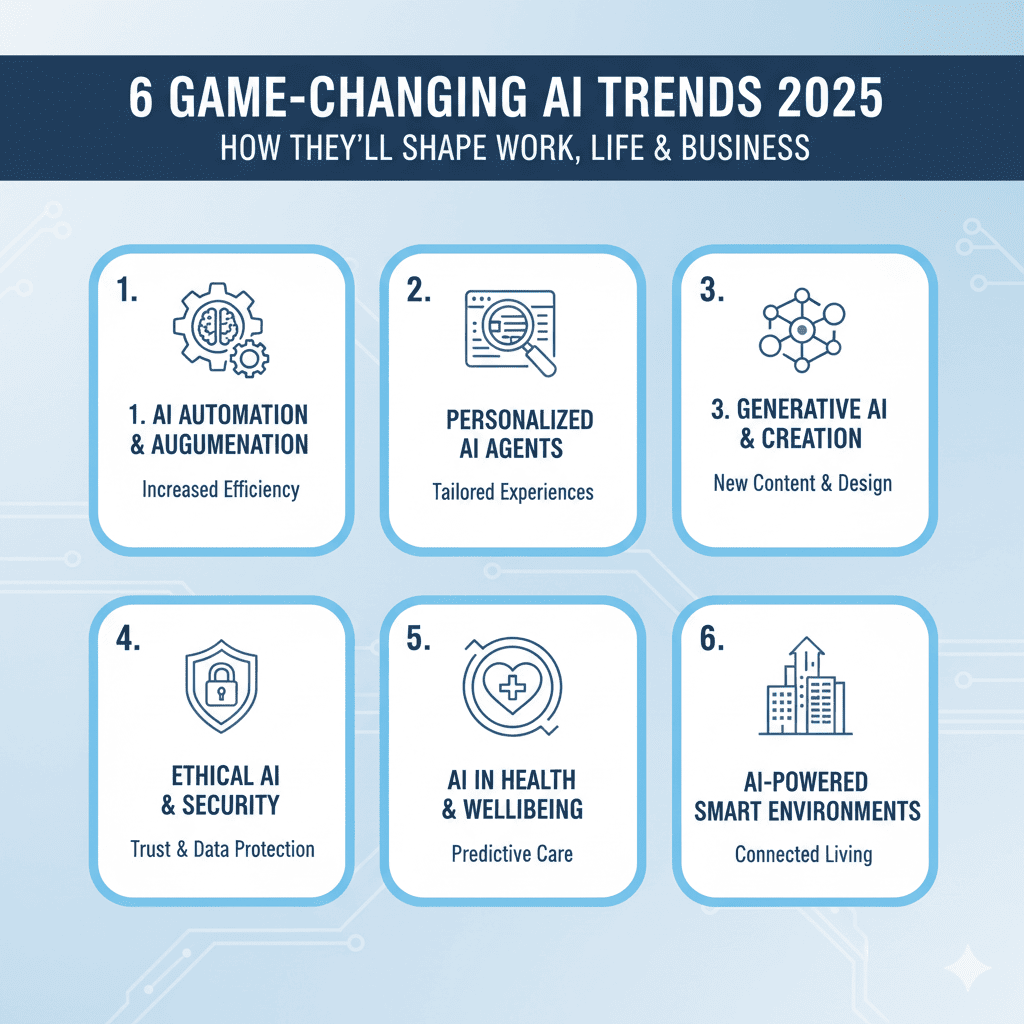
The artificial intelligence revolution isn’t coming—it’s already here, and 2025 marks the year when AI transforms from experimental technology to essential infrastructure. These 6 Game-Changing AI Trends represent more than incremental improvements; they signal a fundamental shift in how we work, live, and conduct business. From autonomous agents that complete entire workflows to AI systems that reason like humans, the landscape is evolving at breathtaking speed.
What makes 2025 different from previous years? The technology has matured beyond the hype cycle. AI is already making the impossible feel possible, and over the past year we’ve seen significant numbers of people and organizations moving from AI experimentation to more meaningful adoption. Companies are no longer asking “Should we use AI?” but rather “How fast can we deploy AI before our competitors do?”
Understanding these 6 Game-Changing AI Trends isn’t optional for business leaders, professionals, or anyone planning their career trajectory. The gap between AI adopters and laggards is widening rapidly, with early implementers already reporting efficiency gains of 25-50% across various functions. This comprehensive guide breaks down each trend, its practical implications, and how you can position yourself or your organization to capitalize on these seismic shifts.
1. Autonomous AI Agents Transform From Chatbots to Digital Co-Workers
The first of our 6 Game-Changing AI Trends represents perhaps the most dramatic shift: we’ll begin to see a shift from chatbots and image generators toward “agentic” systems that can act autonomously to complete tasks, rather than simply answer questions. This evolution transforms AI from passive tools into proactive team members.
Understanding the Agent Revolution
Traditional AI systems respond to prompts and answer questions. AI agents, by contrast, can plan multi-step workflows, make decisions independently, execute complex tasks across multiple systems, and adapt to changing conditions in real-time. AI agents leverage the power of generative AI to understand context, learn from interactions, and make decisions, functioning more like autonomous colleagues than software tools.
The distinction is critical. While ChatGPT might draft a marketing email when prompted, an AI agent could draft the email, schedule its delivery via your CRM, monitor performance metrics, and automatically adjust future campaigns based on results—all with minimal human oversight. This represents a quantum leap in capability.
Real-World Applications Across Industries
Organizations that embrace these trends early will establish significant competitive advantages, and the applications are remarkably diverse:
Customer Service: AI agents now handle complex customer inquiries from start to finish, accessing knowledge bases, processing transactions, and escalating only truly exceptional cases to humans. At least one Mega-Cap tech company will claim $1B in cost savings from agent deployments during the year.
Financial Operations: Agents handle invoice matching, budget routing, and reconciliation autonomously, cutting processing times by up to 50%. They can analyze contracts, flag discrepancies, and even negotiate routine terms.
Healthcare Coordination: AI agents schedule appointments, manage patient intake, coordinate follow-up care, and handle insurance verification—reducing wait times and administrative burden on medical staff.
Human Resources: From onboarding new employees to processing leave requests and answering policy questions, HR agents provide 24/7 support while freeing human HR professionals for strategic initiatives.
The Adoption Timeline and Challenges
The earliest agents will be those for small, structured internal tasks with little money involved — for instance, helping change your password on the IT side, or reserving time off for vacations in HR systems. Companies are wisely starting with low-risk, high-volume tasks before expanding to more critical functions.
However, challenges remain. These systems still work by predicting the next word, and sometimes that will lead to errors or inaccuracies. So there will still be a need for humans to check in on them every now and then. The key is implementing appropriate oversight frameworks—automating routine decisions while maintaining human review for high-stakes scenarios.
82% of organizations plan to integrate AI agents by 2026, making this one of the fastest technology adoption curves in business history. The race is on, and early movers are already demonstrating competitive advantages through improved efficiency, reduced costs, and enhanced customer experiences.
2. Advanced Reasoning Models Unlock Complex Problem-Solving
The second of our 6 Game-Changing AI Trends addresses a fundamental limitation of previous AI systems: the ability to think through problems systematically. Models with advanced reasoning capabilities, like OpenAI o1, can already solve complex problems with logical steps that are similar to how humans think before responding to difficult questions.
How Reasoning Models Work Differently
Most AI models generate immediate responses based on pattern recognition—essentially autocomplete on steroids. Reasoning models work differently. They break complex problems into steps, consider multiple approaches, evaluate potential solutions, and explain their thought process transparently.
When OpenAI revealed o1 in September, it introduced a new paradigm in how large language models work. Two months later, the firm pushed that paradigm forward in almost every way with o3—a model that just might reshape this technology for good. The breakthrough lies in training models to “think” before responding, dramatically improving accuracy on complex tasks.
Transformative Applications
These capabilities will continue to be useful in fields like science, coding, math, law and medicine, allowing models to compare contracts, generate code and execute multistep workflows. The implications extend across virtually every knowledge-intensive profession:
Legal Analysis: Reasoning models can review contracts, identify potential issues, compare terms across documents, and suggest modifications—completing in hours what might take junior attorneys days.
Scientific Research: These tools having a measurable impact on the throughput of the people and institutions who are working on these huge problems, such as designing sustainable materials and accelerating development of life-saving drugs.
Software Development: Instead of generating code snippets, reasoning models can architect entire features, anticipate edge cases, write comprehensive tests, and even refactor existing codebases intelligently.
Medical Diagnosis: By systematically considering symptoms, patient history, and medical literature, reasoning AI can assist physicians in diagnosing complex conditions and recommending treatment protocols.
Performance Improvements
We are likely to see improved multimodal model performance and rapid advancement in reasoning models, which will complement the gains we see in core LLM capabilities when the GPT-5 class models get released in 2025. Each generation demonstrates measurably better performance on standardized tests, professional benchmarks, and real-world tasks.
The economic implications are staggering. Tasks that previously required senior experts can now be accomplished with AI assistance by less experienced professionals, dramatically expanding the effective capacity of knowledge workers and reducing the cost of expertise-dependent services.
3. Multimodal AI Enables Natural, Human-Like Interactions
The third of our 6 Game-Changing AI Trends breaks down the barriers between different types of information. Multimodal AI processes information from text, images, audio and video. It allows for more intuitive interactions and significantly improves the accuracy of AI outputs.
Beyond Text-Only AI
Early AI systems operated in silos—text models handled language, image models processed pictures, and never the twain shall meet. Multimodal AI integrates these capabilities, allowing systems to understand the context across different formats, combine information from multiple sources, respond appropriately to mixed-media inputs, and generate outputs in whichever format makes most sense.
This human-centric approach mirrors how people actually communicate and process information. We don’t think in text-only or image-only terms; we integrate information fluidly across modalities. Now AI can do the same.
Practical Business Applications
For example, in financial services, this could involve analyzing market commentary videos and considering non-verbal cues, like tone of voice and facial expressions, alongside the spoken words for a more nuanced understanding of market sentiment. The applications extend far beyond finance:
Quality Control in Manufacturing: Systems can simultaneously analyze visual defects, acoustic signatures, sensor data, and operational logs to identify issues faster and more accurately than single-modality systems.
Customer Experience: AI can assess customer sentiment not just from words but from tone, facial expressions (in video calls), and contextual cues, enabling more empathetic and effective responses.
Content Creation: Multimodal systems can generate marketing campaigns that integrate copy, visuals, and even audio/video elements, maintaining consistent messaging across all formats.
Accessibility: By seamlessly translating between modalities, multimodal AI makes information accessible to people with different abilities—converting speech to text, describing images verbally, or translating text into sign language.
The Competitive Advantage
Companies implementing multimodal AI report significant advantages in understanding customer needs, creating engaging content, processing complex data streams, and delivering superior user experiences. As these systems become more sophisticated, the gap between multimodal-enabled organizations and those relying on single-modality AI will continue widening.
4. Enterprise-Wide AI Integration Moves Beyond Pilot Projects
The fourth of our 6 Game-Changing AI Trends represents a maturation of AI deployment strategies. Organizations are moving beyond pilot projects to deploy AI agents across entire business functions. Unlike previous implementations that focused on single-use cases, 2025 marks the era of comprehensive AI agent ecosystems.
From Experiments to Infrastructure
The shift from experimentation to production represents a fundamental change in how organizations approach AI. Previously, companies ran isolated AI pilots—a chatbot here, an analytics tool there. Now, they’re building integrated AI ecosystems where multiple agents work together, data flows seamlessly across systems, AI becomes embedded in core workflows, and human-AI collaboration is architected intentionally.
Nearly 70% of Fortune 500 companies already use Microsoft 365 Copilot to tackle plenty of repetitive and mundane tasks, such as sifting through email and taking notes during Teams meetings. But 2025 sees these tools evolving from productivity helpers to strategic infrastructure.
Measuring Real Business Impact
Companies implementing enterprise-wide AI agents report average productivity gains of 35% and operational cost reductions of 20-30%. These aren’t theoretical projections—they’re documented results from companies that have moved beyond pilots to production deployment.
The return on investment manifests in multiple ways:
Time Savings: Tasks that consumed hours now complete in minutes. Teams redirect that time toward higher-value activities requiring human creativity and judgment.
Error Reduction: AI systems maintain consistent quality across thousands of repetitive tasks, eliminating the variability inherent in human processing of routine work.
Scalability: Organizations can handle dramatically increased workload without proportional headcount growth, enabling expansion without operational bloat.
24/7 Operations: AI agents don’t sleep, enabling businesses to provide continuous service and process work around the clock.
Implementation Best Practices
Rigorous assessment and validation of AI risk management practices and controls will become nonnegotiable. Successful enterprise deployments follow clear patterns:
Start with high-impact, structured processes where AI can deliver immediate value. Build strong governance frameworks before scaling. Invest heavily in change management and employee training. Establish clear metrics and accountability for AI performance. Implement robust monitoring and continuous improvement processes.
Company leaders will no longer have the luxury of addressing AI governance inconsistently or in pockets of the business. As AI becomes mission-critical infrastructure, it demands the same rigor as financial systems, security protocols, and other enterprise foundations.
5. AI-Powered Cybersecurity Arms Race Intensifies
The fifth of our 6 Game-Changing AI Trends addresses both opportunity and threat. In 2025, AI will help bolster defenses, identify and combat threats, automate manual security tasks and accelerate response times. However, this also leads to an “arms race” between defenders and attackers, as adversaries leverage AI for more sophisticated attacks.
The Dual Nature of AI in Security
AI represents both the problem and the solution in cybersecurity. On the defensive side, AI systems can monitor massive data streams for anomalies, identify novel attack patterns faster than humans, automate response to common threats, and predict vulnerabilities before exploitation.
The stakes are higher than ever as we face the fallout from what Senate Intelligence Committee Chairman Mark Warner recently called the “worst telecom hack in our nation’s history – by far” and the ongoing campaign by foreign adversaries targeting U.S. critical infrastructure.
On the offensive side, malicious actors use AI to craft more convincing phishing attacks, automatically identify and exploit vulnerabilities, adapt attacks in real-time to evade detection, and scale attacks to unprecedented levels.
Industry-Specific Impacts
Different sectors face varying threat profiles. Manufacturing organizations face the biggest threat from ransomware and data extortion actors throughout 2025, with retail, construction, healthcare, and technology sectors also experiencing high levels of targeting. Financial institutions can use AI to detect counterfeit documents, and manufacturers can use it to keep data safe and identify potential risks.
The media and entertainment industry faces unique challenges from deepfakes and synthetic media used for disinformation campaigns. AI detection systems are evolving to identify manipulated content, but the race between synthetic generation and detection continues escalating.
Practical Defense Strategies
We think we’ll see an AI-enabled cyberattack that creates billions in economic damage for a specific company or government entity in 2025. This sobering prediction underscores the urgency of robust AI-powered defenses.
Organizations should implement zero-trust architectures enhanced by AI, deploy AI-powered endpoint detection and response systems, use AI to continuously assess and prioritize vulnerabilities, train AI systems on organization-specific threat patterns, and maintain human expertise for strategic security decisions.
The most effective approach combines AI automation for speed and scale with human expertise for context and strategic thinking. AI excels at processing vast amounts of data and responding to known threats instantly, while humans provide the creativity and strategic insight needed to anticipate novel attacks.
6. Sustainable AI and Energy-Efficient Infrastructure
The sixth of our 6 Game-Changing AI Trends addresses a critical challenge: the massive energy requirements of AI systems and the innovative solutions emerging to make AI sustainable. AI will accelerate the energy transition. It will also help companies meet their sustainability goals – especially those in emissions-intensive sectors like manufacturing, construction and transportation – if they take the right approach.
The Energy Challenge
AI’s computational demands are substantial. Training large models requires enormous energy, and inference at scale consumes significant power. AI requires so much energy that there’s not enough electricity (or computational power) for every company to deploy AI at scale.
However, while AI needs resources like energy, innovative solutions are helping with this challenge. Even as global datacenter workloads in 2020 were roughly nine times what they were in 2010, for example, datacenter electricity demand increased only 10%. This remarkable efficiency gain came through hardware optimization, improved cooling systems, more efficient algorithms, and better utilization of computing resources.
Infrastructure Innovation
Microsoft is working on its own and with others, like AMD, Intel and NVIDIA, to make its hardware more efficient, from its custom silicon series, Azure Maia and Cobalt, to its liquid cooling heat exchanger unit designed to efficiently cool large-scale AI systems.
The infrastructure innovations include custom AI chips optimized for specific tasks, liquid cooling systems that dramatically improve efficiency, renewable energy integration for datacenters, and edge computing that processes data locally, reducing transmission and centralization costs.
In the coming years, new datacenters that support AI will come online and consume zero water for cooling and the company will expand its use of superefficient liquid cooling systems such as cold plates.
AI for Sustainability
The paradox of sustainable AI is that AI itself becomes a tool for environmental progress. AI will be a driver for sustainability through multiple mechanisms:
Energy Grid Optimization: AI systems optimize renewable energy generation and distribution, predicting demand patterns and managing supply to maximize efficiency.
Materials Science: AI accelerates discovery of sustainable materials, reducing the time from concept to commercialization from years to months.
Supply Chain Efficiency: AI optimizes logistics and manufacturing processes, reducing waste, energy consumption, and emissions across entire supply chains.
Climate Modeling: Advanced AI models improve climate predictions, enabling better planning and mitigation strategies.
Strategic Deployment
We won’t hit an equilibrium of supply and demand in 2025. That will make it wise to treat AI as a value play, not a volume one. Use it in more and more areas, yes, but also be strategic about how and where you roll AI out.
Organizations should prioritize AI deployment in areas with highest ROI, use smaller, more efficient models when possible, implement AI interfaces that discourage wasteful usage, and continuously monitor and optimize AI system efficiency.
Based on PwC’s work with clients and our analysis of technology and industry trends, we’re confident that adopting AI in R&D can reduce time-to-market 50% and lower costs 30% in industries like automotive and aerospace. The sustainability gains extend beyond environmental impact to economic efficiency.
Preparing for the AI-Transformed Future
These 6 Game-Changing AI Trends collectively represent more than technological evolution—they signal a fundamental transformation in how humans and machines collaborate. In 2025, AI will evolve from a tool for work and home to an integral part of both.
Taking Action Today
Understanding trends isn’t enough; action determines outcomes. Whether you’re a business leader, professional, or entrepreneur, several steps position you for success:
Invest in AI Literacy: Technical expertise isn’t required, but understanding AI capabilities, limitations, and implications becomes essential across all roles.
Experiment Actively: The learning curve is steep but manageable. Start with accessible tools, test applications relevant to your work, and build intuition through hands-on experience.
Build Strategic Partnerships: The price of GPT-4 class models has fallen ~90% since initial release in March 2023, making trailing-edge intelligence significantly more accessible. Powerful AI tools are increasingly affordable, but integration requires expertise. Partner with vendors, consultants, or internal teams who understand both AI and your industry.
Focus on Human-AI Collaboration: The future isn’t humans versus AI—it’s humans augmented by AI. Design workflows that leverage AI’s strengths (speed, scale, consistency) while preserving human judgment for strategy, creativity, and ethics.
Prioritize Governance and Ethics: Even if the specifics of AI assessment and validation are not mandated, stakeholders will demand it — just as they demand confidence in other decision-critical information. Establish clear policies, accountability structures, and ethical frameworks before deploying AI at scale.
The Competitive Imperative
The gap between AI leaders and laggards will widen dramatically in 2025. Organizations that successfully integrate these 6 Game-Changing AI Trends will enjoy substantial advantages in efficiency, innovation capacity, customer experience, and cost structure.
Conversely, organizations that delay adoption risk falling irreversibly behind. The window for experimentation is closing; production deployment is the new standard. The question isn’t whether to embrace these trends but how quickly and effectively you can implement them.
A Transformative Year Ahead
In 2025, one trend is certain: AI will continue to drive innovation and unlock new potential for people and organizations around the globe. These 6 Game-Changing AI Trends—autonomous agents, advanced reasoning, multimodal capabilities, enterprise integration, cybersecurity evolution, and sustainable infrastructure—collectively reshape the technological and economic landscape.
The transformation won’t be uniform or easy. Challenges around data privacy, algorithmic bias, job displacement, and security will require ongoing attention. But the potential benefits—productivity gains, scientific breakthroughs, improved decision-making, and solutions to previously intractable problems—justify the effort.
Also read this:
Perplexity Upgrades Comet for True Multitasking Across Tabs: The Revolutionary 2025 Update
AI Rendering Explained: Faster, Smarter & More Realistic Than Ever
5 Creative Ways Gemini Can Help You Master Digital Art with AI: The Ultimate 2025 Guide