
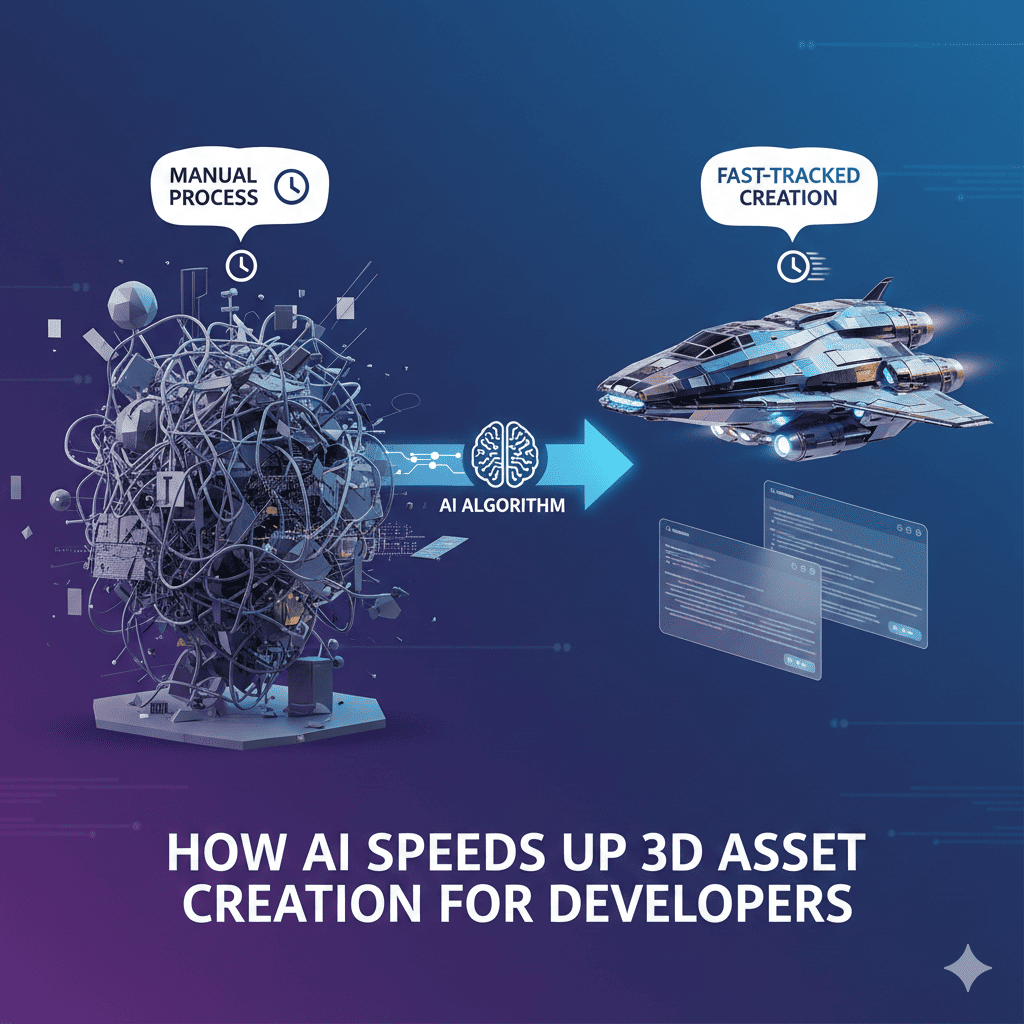
The game development and digital content creation industries face a persistent challenge: creating high-quality 3D assets is incredibly time-consuming and resource-intensive. Traditional workflows require skilled artists spending hours or even days modeling, texturing, rigging, and animating individual assets. Enter artificial intelligence, which is revolutionizing 3D asset creation by automating tedious processes, accelerating workflows, and enabling developers to achieve in hours what previously took weeks. This technological transformation is democratizing game development and empowering both indie studios and major developers to create richer, more detailed virtual worlds.
The impact of AI on 3D asset creation extends beyond simple time savings. These tools enable smaller teams to compete with larger studios, allow rapid prototyping and iteration, reduce production costs dramatically, and unlock creative possibilities that were previously impractical. Understanding how AI accelerates 3D asset creation reveals the future of digital content development and the opportunities available to forward-thinking developers.
Understanding AI-Powered 3D Asset Creation
Before exploring specific applications, it’s important to understand how AI transforms traditional 3D asset creation workflows. Machine learning models trained on millions of existing 3D models, textures, and animations can generate new assets, automate repetitive tasks, and even understand designer intent from simple inputs like sketches or text descriptions. These systems use neural networks, generative adversarial networks, diffusion models, and other sophisticated AI architectures to bridge the gap between concept and finished asset.
The revolution in 3D asset creation doesn’t eliminate the need for skilled artists but amplifies their capabilities, allowing them to focus on creative direction, refinement, and the aspects of development that truly require human judgment and artistic vision.
1. Text-to-3D Model Generation
Natural Language Model Creation
One of the most revolutionary advances in 3D asset creation is the ability to generate 3D models from simple text descriptions. Developers can describe what they need in plain language, and AI systems produce usable 3D assets within minutes.
Text-to-3D capabilities include:
- Simple object generation from basic descriptions
- Style specification: realistic, stylized, low-poly, high-detail
- Material and texture suggestion in text prompts
- Multiple variation generation from single description
- Iterative refinement through conversational prompts
- Scale and proportion specification through descriptive language
- Functional characteristic inclusion: openable doors, moving parts
Concept-to-Model Translation
AI systems can interpret conceptual descriptions and translate abstract ideas into concrete 3D geometry, accelerating the early stages of 3D asset creation.
Conceptual translation features:
- Mood and atmosphere translation into visual elements
- Function-based generation: “a futuristic weapon” or “medieval furniture”
- Genre-appropriate style application automatically
- Cultural and historical accuracy in generated assets
- Fantastical and impossible object creation from imagination
- Composite concept combination: “steampunk vehicle with organic elements”
- Reference-free generation requiring no existing examples
Multi-Language Support and Global Accessibility
AI-powered 3D asset creation tools support multiple languages, democratizing access for developers worldwide regardless of their native language.
Language accessibility benefits:
- Native language prompt input for non-English speakers
- Cultural context understanding in descriptions
- Regional terminology and naming convention support
- Translation quality maintaining design intent
- Multilingual team collaboration facilitation
- Documentation and tutorial availability across languages
- Reduced language barrier impact on creative expression
2. Image-to-3D Model Conversion
Single Image 3D Reconstruction
AI can analyze a single photograph or concept art image and generate plausible 3D geometry, dramatically accelerating 3D asset creation from reference materials.
Single-image reconstruction features:
- Depth map estimation from monocular images
- Occluded surface intelligent prediction
- Texture extraction and UV mapping automation
- Scale estimation from contextual clues
- Material property inference from appearance
- Normal map generation for surface detail
- Lighting condition separation from inherent colors
Multi-View Photogrammetry Enhancement
Traditional photogrammetry requires dozens or hundreds of photos, but AI-enhanced 3D asset creation can produce quality results from far fewer images.
Enhanced photogrammetry includes:
- Sparse image set reconstruction
- Missing angle interpolation and hallucination
- Automatic alignment and registration
- Noise and artifact reduction
- Mesh optimization and cleanup automation
- Texture blending across inconsistent lighting
- Real-time preview during capture sessions
Concept Art Direct Conversion
Artists can create 2D concept art, and AI converts these drawings directly into 3D models, maintaining artistic style while adding dimensional depth to 3D asset creation workflows.
Concept art conversion features:
- Line art interpretation into 3D geometry
- Style preservation from 2D to 3D translation
- Artistic exaggeration maintenance in proportions
- Multiple angle synthesis from single view
- Painted texture direct application to models
- Sketch-level input producing detailed output
- Iterative refinement maintaining artistic intent
3. Automated Mesh Generation and Optimization
Topology Optimization and Retopology
AI dramatically accelerates the tedious process of creating clean topology, essential for animation and rendering efficiency in 3D asset creation.
Topology automation includes:
- Quad-dominant mesh generation for animation
- Edge flow optimization following natural contours
- Polygon count targeting for performance requirements
- UV seam placement in inconspicuous locations
- Level of detail automatic generation
- Subdivision surface preparation
- Animation-friendly topology for deforming meshes
Mesh Repair and Cleanup
Scanned or generated meshes often contain errors that AI can automatically detect and fix, saving hours of manual work in 3D asset creation.
Mesh repair capabilities:
- Non-manifold geometry detection and correction
- Hole filling with appropriate geometry
- Flipped normal automatic detection and fixing
- Duplicate vertex merging
- Intersecting geometry resolution
- Thin wall and problematic feature identification
- Watertight mesh guarantee for 3D printing
Procedural Detail Addition
AI can intelligently add geometric detail to base meshes, enhancing 3D asset creation by automating the creation of fine surface features.
Detail generation includes:
- Surface wear and damage procedural addition
- Panel line and detail embossing
- Ornamental pattern application following surface contours
- Weathering and aging geometry creation
- Rivet, bolt, and mechanical detail placement
- Organic detail like scales, bark, or skin texture
- Style-consistent decoration generation
4. Intelligent Texturing and Material Creation
AI-Powered Texture Generation
Creating convincing textures is one of the most time-consuming aspects of 3D asset creation, but AI can generate complete material sets in seconds.
Texture generation capabilities:
- Physically-based rendering material creation
- Albedo, roughness, metallic, and normal map generation
- Style-consistent texture application across asset collections
- Resolution-independent texture synthesis
- Seamless texture generation eliminating visible tiling
- Weathering and wear pattern intelligent placement
- Color palette extraction and application from references
Automatic UV Unwrapping
UV mapping is notoriously tedious in traditional 3D asset creation, but AI can automatically create efficient UV layouts.
UV unwrapping features:
- Optimal seam placement minimizing visibility
- Efficient space utilization maximizing texture resolution
- Consistent texel density across surfaces
- Automatic packing of multiple objects
- Island orientation optimization for painting
- Overlapping UV creation for symmetric objects
- Custom resolution priority for important surfaces
Material Transfer and Style Matching
AI can analyze existing materials and apply similar styles to new assets, ensuring consistency across 3D asset creation projects.
Material transfer includes:
- Style extraction from reference materials
- Automatic application to new geometry types
- Scale and proportion adjustment for different objects
- Lighting condition normalization
- Wear pattern consistency across asset sets
- Color palette matching and harmonization
- Material property inference from appearance
5. Rigging and Animation Automation
Automatic Skeleton Generation
Rigging characters and creatures traditionally requires specialized expertise, but AI automates skeleton creation in 3D asset creation workflows.
Auto-rigging features include:
- Anatomically correct bone placement
- Joint orientation optimization for animation
- Inverse kinematics chain setup
- Humanoid, creature, and mechanical rig templates
- Custom appendage and limb structure handling
- Weight painting initial pass automation
- Control rig generation for animators
Motion Capture Data Processing
AI enhances motion capture workflows, cleaning data and adapting animations to different skeletons, accelerating animated 3D asset creation.
Motion capture enhancements:
- Noise filtering and smoothing
- Marker occlusion intelligent interpolation
- Foot sliding and ground contact correction
- Motion retargeting between different skeleton proportions
- Performance capture facial animation processing
- Multiple actor interaction conflict resolution
- Real-time preview during capture sessions
Procedural Animation Generation
AI can generate realistic animations without motion capture, further streamlining 3D asset creation for animated content.
Procedural animation includes:
- Walk and run cycle generation for bipeds and quadrupeds
- Physics-based secondary motion: clothing, hair, accessories
- Behavioral animation: idle, attention, reaction states
- Lip-sync animation from audio analysis
- Crowd animation variation preventing repetition
- Environmental interaction: climbing, swimming, flying
- Combat and action sequence generation
6. Asset Variation and Kitbashing
Intelligent Asset Variation
Creating asset variety is crucial for believable worlds, and AI accelerates generating variations in 3D asset creation while maintaining consistency.
Variation generation includes:
- Proportional adjustment within style guidelines
- Damage state and wear level variation
- Color and material palette swapping
- Modular component recombination
- Detail level scaling for performance tiers
- Seasonal and environmental adaptation
- Cultural and regional style variation
Smart Kitbashing and Component Assembly
AI understands how modular components fit together, enabling rapid 3D asset creation through intelligent assembly of existing parts.
Kitbashing automation features:
- Compatible component identification
- Attachment point automatic detection
- Scale normalization across different source assets
- Gap filling and transition geometry generation
- Style consistency enforcement
- Structural logic validation
- Collision detection preventing intersections
Asset Family Generation
From a single hero asset, AI can generate entire families of related objects, dramatically expanding 3D asset creation output.
Family generation includes:
- Size variation: small, medium, large versions
- Quality tier creation from single source
- Damaged and pristine state generation
- Age progression and historical variants
- Functional variation: open, closed, broken states
- Modular accessory and attachment variants
- Thematic set completion from exemplars
7. Level of Detail Generation
Automatic LOD Creation
Games require multiple detail levels for performance optimization, and AI automates LOD creation in 3D asset creation pipelines.
LOD generation features:
- Intelligent polygon reduction maintaining silhouette
- Texture resolution reduction and rebaking
- Visual importance-based detail preservation
- Smooth transition between LOD levels
- Impostor and billboard generation for distant objects
- Memory budget targeting
- Platform-specific optimization profiles
Performance-Aware Optimization
AI considers target platforms and performance requirements, optimizing 3D asset creation for specific hardware constraints.
Performance optimization includes:
- Polygon budget adherence across asset collections
- Draw call minimization through mesh combination
- Texture memory optimization
- Shader complexity adjustment
- Collision mesh simplified generation
- Occlusion culling preparation
- Mobile platform specific optimizations
Dynamic Detail Adjustment
Some AI systems enable runtime detail adjustment, adapting 3D asset creation outputs to current performance conditions.
Dynamic adjustment features:
- Real-time LOD switching intelligence
- Adaptive texture streaming
- Procedural detail activation based on proximity
- Performance monitoring integration
- Quality setting automatic adjustment
- Bandwidth-aware asset loading
- Battery life consideration for mobile devices
8. Asset Quality Assurance
Automated Error Detection
AI can identify problems in 3D asset creation that might cause rendering issues, crashes, or visual artifacts.
Error detection includes:
- Non-game-ready geometry identification
- Texture resolution consistency checking
- Naming convention compliance verification
- File format compatibility validation
- Metadata completeness checking
- Asset dependency tracking
- Performance impact prediction
Style Consistency Enforcement
Maintaining visual consistency across large asset libraries is challenging, but AI can enforce style guidelines in 3D asset creation.
Consistency checking features:
- Proportional relationship verification
- Color palette compliance checking
- Material property range enforcement
- Detail density consistency across assets
- Polycount budget adherence
- Texture resolution standards verification
- Art direction guideline automated enforcement
Integration Testing Automation
AI can test how assets perform in actual game environments, catching 3D asset creation issues before they reach players.
Integration testing includes:
- In-engine performance measurement
- Visual quality verification at target distances
- Animation blending and transition checking
- Collision detection validation
- Lighting and shadow behavior verification
- Physics interaction testing
- Platform compatibility confirmation
9. Collaborative AI Assistance
Real-Time Suggestion Systems
AI provides contextual suggestions during 3D asset creation, offering alternatives and improvements as artists work.
Suggestion system features:
- Alternative design variations on-the-fly
- Common error prevention warnings
- Style reference recommendation
- Technique suggestion for specific tasks
- Shortcut and workflow optimization tips
- Tutorial content contextual linking
- Best practice automated enforcement
Team Workflow Integration
AI coordinates between team members, managing asset pipelines and ensuring smooth 3D asset creation collaboration.
Workflow integration includes:
- Asset dependency tracking and management
- Version control intelligent branching
- Conflict detection between concurrent edits
- Task priority recommendation
- Progress tracking and bottleneck identification
- Resource allocation optimization
- Communication trigger for required coordination
Learning from Team Practices
AI systems adapt to studio-specific workflows, learning preferences and automating 3D asset creation according to team standards.
Adaptive learning features:
- Studio style guideline internalization
- Individual artist preference recognition
- Common modification pattern automation
- Quality standard learning from approvals
- Pipeline customization based on usage patterns
- Terminology and naming convention adoption
- Tool configuration optimal preset generation
10. Emerging Technologies in AI Asset Creation
Neural Radiance Fields
NeRF technology creates photorealistic 3D representations from photos, pushing 3D asset creation toward unprecedented realism and efficiency.
NeRF applications include:
- Scene capture from casual photography
- Real-world object digitization
- Lighting and material accurate capture
- View synthesis from sparse data
- Real-time rendering optimization
- Conversion to traditional mesh representations
- Virtual production environment creation
Generative Adversarial Networks
GANs enable creating entirely novel assets by learning from existing examples, expanding creative possibilities in 3D asset creation.
GAN capabilities include:
- Training on studio-specific asset libraries
- Novel design generation within learned style
- Concept exploration and ideation assistance
- Style transfer between different asset types
- Hybrid concept generation combining influences
- Controlled randomization within parameters
- Quality assessment against training examples
Diffusion Models for 3D
The latest AI architectures bring unprecedented control and quality to 3D asset creation, with intuitive interfaces and impressive results.
Diffusion model features:
- High-quality geometry generation
- Fine-grained control over output characteristics
- Iterative refinement maintaining coherence
- Multi-modal input: text, image, sketch combination
- Consistent style across generation sessions
- Rapid iteration and experimentation
- Integration with traditional 3D software
Implementation Strategies for Development Teams
Successfully integrating AI into 3D asset creation pipelines requires thoughtful implementation considering team skills, project requirements, and tool selection.
Implementation best practices:
- Start with pilot projects testing AI tools
- Invest in team training and skill development
- Establish clear quality standards and validation processes
- Maintain human oversight and artistic direction
- Combine AI automation with manual refinement
- Document workflows and share knowledge
- Gradually expand AI usage as confidence grows
- Monitor time savings and quality improvements
Challenges and Considerations
While AI dramatically accelerates 3D asset creation, developers should understand current limitations and challenges.
Common challenges include:
- Initial learning curve for new tools
- Quality inconsistency requiring human review
- Style control limitations in fully automated systems
- Legal and copyright considerations for AI-generated content
- Integration complexity with existing pipelines
- Hardware requirements for local AI processing
- Subscription costs for cloud-based services
- Dependency on third-party service availability
The Future of AI-Powered Asset Creation
The trajectory of AI in 3D asset creation points toward increasingly sophisticated, intuitive, and powerful tools that will continue transforming development workflows.
Future developments include:
- Real-time collaborative AI assistants
- Virtual reality asset creation interfaces
- Brain-computer interface design tools
- Fully autonomous asset pipeline systems
- Photorealistic generation indistinguishable from reality
- Cross-platform asset optimization automation
- Predictive asset need identification
- Emotional impact optimization through AI
Measuring ROI and Success
Quantifying the impact of AI on 3D asset creation helps justify investment and guide implementation decisions.
Success metrics include:
- Time reduction per asset type
- Team productivity increase measurements
- Quality consistency improvement
- Cost savings calculation
- Project timeline acceleration
- Artist satisfaction and creative freedom
- Asset reuse and variation efficiency
- Technical performance improvements
Conclusion
The integration of AI into 3D asset creation represents one of the most significant technological shifts in game development and digital content creation history. What once required teams of specialists working for months can now be accomplished by smaller teams in weeks or even days, democratizing high-quality content creation and enabling creative visions previously constrained by time and budget limitations. From text-to-model generation and intelligent texturing to automated rigging and performance optimization, AI touches every aspect of the 3D asset creation pipeline.
Also read this:
Procedural Generation: How AI Creates Entire Game Worlds That Feel Alive and Endless
AI Food & Restaurant Finders Every Traveler Should Use: Your Ultimate Culinary Travel Companion
How Fashion Designers Are Using AI to Create Viral Collections: The Digital Revolution in Fashion