
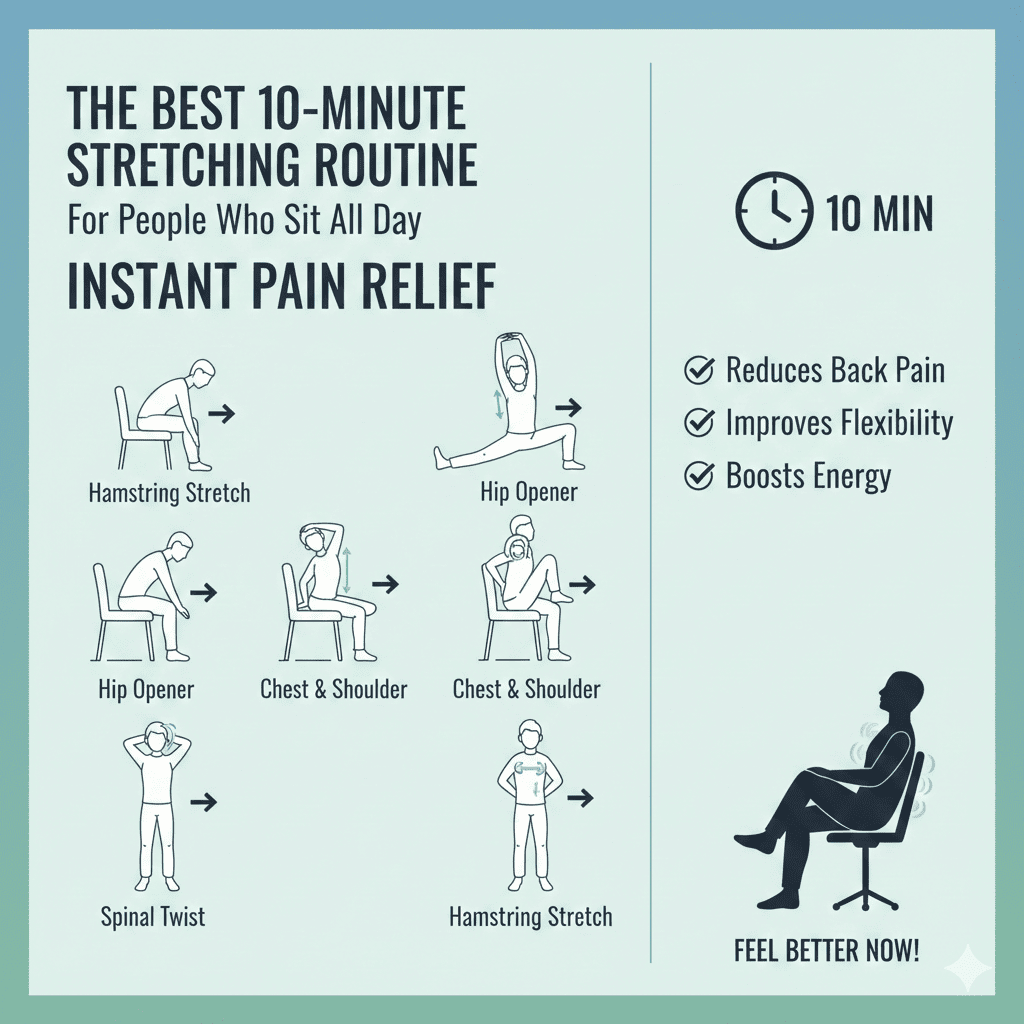
10-Minute Stretching Routine If you spend most of your day sitting at a desk, you’re probably familiar with the nagging aches that come with it—tight hips, stiff shoulders, a sore lower back, and neck tension that just won’t quit. The modern sedentary lifestyle is wreaking havoc on our bodies, but there’s good news: a simple 10-minute stretching routine can provide instant relief and prevent chronic pain from taking over your life.
This comprehensive guide will walk you through everything you need to know about combating the negative effects of prolonged sitting. You’ll discover why sitting is so problematic, learn the exact stretches that target desk-related pain, and master a complete 10-minute stretching routine that fits seamlessly into even the busiest schedule.
The Hidden Dangers of Prolonged Sitting
Why Sitting Is Called the New Smoking
10-Minute Stretching Routine Your body wasn’t designed to remain in a seated position for eight to twelve hours daily. When you sit for extended periods, several harmful physiological changes occur simultaneously. Your hip flexors remain in a shortened position for so long that they adapt by actually becoming shorter and tighter. Your glutes essentially shut off, becoming weak and inactive. Your spine compresses under constant pressure, particularly in the lower back region.
Blood circulation slows dramatically when you’re sedentary, reducing oxygen and nutrient delivery to muscles and tissues. This creates a cascade of problems including increased inflammation, reduced metabolic rate, and higher risk of cardiovascular disease. Your posture gradually deteriorates as muscles fatigue from holding the seated position, leading to the characteristic forward head posture, rounded shoulders, and anterior pelvic tilt that plague desk workers.
Research shows that sitting for more than six hours daily increases your risk of early death by up to 40%, even if you exercise regularly. The damage isn’t just physical—prolonged sitting correlates with increased anxiety, depression, and decreased cognitive function. Your body craves movement, and when deprived of it, every system suffers.
The Most Common Pain Points
Lower Back Pain: The lumbar spine bears enormous pressure when sitting, especially with poor posture. The natural curve of your lower back flattens, placing stress on discs and ligaments. Over time, this can lead to chronic pain, disc degeneration, and even herniation.
Hip Tightness: Your hip flexors—the muscles connecting your thigh to your lower back—remain contracted while sitting. After hours in this position, they resist lengthening, creating that characteristic feeling of tightness when you stand up. This tightness pulls on your pelvis, contributing to lower back pain and poor posture.
Neck and Shoulder Tension: Looking at a computer screen typically involves jutting your head forward. For every inch your head moves forward from its natural position, your neck muscles must support an additional ten pounds of weight. This creates chronic tension, trigger points, and often leads to tension headaches.
Tight Chest Muscles: Sitting with shoulders rounded forward shortens your pectoral muscles. This reinforces poor posture and makes it increasingly difficult to maintain proper alignment even when you’re trying.
Why a 10-Minute Stretching Routine Is Your Solution
The Science Behind Strategic Stretching
A targeted 10-minute stretching routine isn’t just about feeling good temporarily—it creates measurable physiological improvements. When you stretch a muscle, you’re increasing blood flow to that tissue, delivering fresh oxygen and nutrients while removing metabolic waste products. This accelerates recovery and reduces inflammation.
Stretching also affects your nervous system. When done correctly, it activates the parasympathetic nervous system, reducing stress hormones like cortisol and promoting relaxation. This is why stretching often feels mentally restorative, not just physically beneficial.
Regular stretching maintains and improves your range of motion, counteracting the adaptive shortening that occurs with prolonged sitting. It reminds your muscles of their full length capacity, preventing the chronic tightness that leads to pain and injury. Think of stretching as a reset button for your musculoskeletal system.
Why Ten Minutes Is the Perfect Duration
Ten minutes is long enough to address all major problem areas created by sitting while short enough to fit into any schedule. This 10-minute stretching routine isn’t about holding each stretch for excessive periods—it’s about efficiently moving through a sequence that targets every area affected by desk work.
You can perform this routine during your lunch break, immediately after work, or even broken into smaller sessions throughout the day. The barrier to entry is so low that there are no valid excuses. No special equipment required, no need to change clothes, and no significant time commitment. Just ten minutes between you and significant pain relief.
Immediate and Long-Term Benefits
The beauty of this 10-minute stretching routine is that you’ll feel immediate improvements. After your first session, you’ll notice increased range of motion, reduced muscle tension, and often complete elimination of acute pain. Your posture will improve, breathing will feel easier, and you’ll likely experience a mood boost from the endorphin release and stress reduction.
Long-term consistency delivers even more impressive results. Regular stretching prevents the development of chronic pain conditions, improves athletic performance if you exercise, enhances sleep quality, and reduces injury risk. Many people report that their daily stretching practice becomes the highlight of their day—a moment of mindful movement in an otherwise hectic schedule.
1. Preparing for Your Stretching Routine
Creating the Right Environment
Find a quiet space where you won’t be interrupted for ten minutes. This could be your office with the door closed, a corner of your home, or even a conference room during lunch break. The location matters less than ensuring you can focus without distractions. Turn off notifications on your phone or computer. This time is for you.
The surface should be comfortable enough for floor-based stretches. A yoga mat is ideal but not necessary—carpet works fine, or you can use a folded towel for cushioning. Make sure the area has enough space to extend your arms and legs fully in all directions.
Consider the temperature. Your muscles stretch more effectively when warm, so avoid extremely cold environments. If possible, do a minute or two of light movement before starting—march in place, do arm circles, or perform gentle torso twists. This brief warm-up increases blood flow and prepares tissues for stretching.
Understanding Proper Stretching Technique
Effective stretching follows specific principles that maximize benefits while minimizing injury risk. Always move into stretches slowly and with control. Jerking or bouncing creates micro-tears in muscle fibers and triggers the stretch reflex, which actually causes muscles to contract rather than lengthen.
Find the point of mild tension—you should feel a gentle pull, never pain. Sharp, burning, or shooting sensations indicate you’ve gone too far. Back off slightly and hold at a comfortable intensity. Remember, stretching should feel challenging but never agonizing.
Breathing is crucial during your 10-minute stretching routine. Never hold your breath. Instead, breathe deeply and steadily, using your breath to deepen stretches on the exhale. This oxygenates tissues, promotes relaxation, and allows you to access greater range of motion safely.
What Not to Do
Avoid comparing your flexibility to others or to idealized images you’ve seen. Everyone’s body is different, with unique bone structures, muscle lengths, and joint capabilities. Your only competition is yourself—focus on gradual improvement over time.
Don’t stretch cold muscles first thing in the morning or immediately after sitting for hours. Spend a few minutes moving gently first. Never force a stretch or push through significant pain. Discomfort is acceptable; pain is a warning signal to stop.
Finally, don’t hold your stretches for too long. While older recommendations suggested holding stretches for 30-60 seconds, research now shows that 15-30 seconds is equally effective for most people, and this shorter duration makes the routine more sustainable.
2. The Complete 10-Minute Stretching Routine
Neck Release Sequence (90 seconds)
Neck Rolls: Begin by sitting or standing tall with shoulders relaxed. Slowly drop your right ear toward your right shoulder, feeling the stretch along the left side of your neck. Hold for 10 seconds. Return to center, then drop your left ear to your left shoulder, holding for 10 seconds. Next, gently lower your chin toward your chest, stretching the back of your neck for 10 seconds. Finally, look upward, feeling the stretch along your throat and front of neck for 10 seconds.
Neck Rotation: 10-Minute Stretching Routine Turn your head to look over your right shoulder, keeping your chin level. You should feel the stretch on the left side of your neck. Hold for 15 seconds, then slowly rotate to look over your left shoulder and hold for 15 seconds. Never force this movement—gentle rotation is sufficient.
Levator Scapulae Stretch: This targets a muscle that connects your neck to your shoulder blade and is often a primary source of neck pain. Turn your head 45 degrees to the right, then look down toward your armpit. Place your right hand on the back of your head and apply gentle pressure, increasing the stretch. Hold for 20 seconds, then repeat on the left side.
Shoulder and Upper Back Release (90 seconds)
Shoulder Rolls: Roll both shoulders backward in large, slow circles five times, then forward five times. This mobilizes the shoulder joints and begins releasing tension in the upper back and chest.
Cross-Body Shoulder Stretch: Bring your right arm across your body at chest height. Use your left hand to gently pull the right arm closer to your chest. You should feel this stretch in the back of your right shoulder. Hold for 20 seconds, then switch arms.
Doorway Chest Stretch: Stand in a doorway or corner. Place your forearms on the door frame with elbows at 90 degrees. Lean forward gently until you feel a stretch across your chest and front of shoulders. This counters the rounded shoulder posture from sitting. Hold for 30 seconds. This is one of the most important stretches in any 10-minute stretching routine for desk workers because it directly opposes your default sitting position.
Thread the Needle: Get on hands and knees. Slide your right arm under your body toward the left side, lowering your right shoulder and head to the floor. You’ll feel a stretch through your upper back and shoulder. Hold for 20 seconds, then switch sides.
Spine Mobilization (120 seconds)
Cat-Cow Stretch: Start on hands and knees with a neutral spine. Inhale as you drop your belly toward the floor, lifting your chest and tailbone—this is cow pose. Exhale as you round your spine toward the ceiling, tucking your tailbone and dropping your head—this is cat pose. Flow between these positions for 45 seconds, moving with your breath. This gentle movement lubricates the spine and mobilizes every vertebra.
Seated Spinal Twist: Sit on the floor with legs extended. Bend your right knee and place your right foot on the outside of your left knee. Place your right hand on the floor behind you. Wrap your left arm around your right knee, twisting to look over your right shoulder. This stretch wrings out tension from your spine and massages internal organs. Hold for 30 seconds, then switch sides.
Child’s Pose: Kneel on the floor, sit back on your heels, then fold forward, extending your arms in front of you. Rest your forehead on the floor if possible. This gentle stretch decompresses the spine and creates space between vertebrae. Focus on breathing deeply into your back. Hold for 45 seconds.
Hip Flexor Release (120 seconds)
Kneeling Hip Flexor Stretch: Kneel on your right knee with your left foot flat on the floor in front of you, forming a 90-degree angle. Keep your torso upright and gently press your hips forward. You should feel a strong stretch in the front of your right hip. For a deeper stretch, raise your right arm overhead and lean slightly to the left. Hold for 30 seconds, then switch sides. This stretch directly counters the shortened position your hip flexors maintain while sitting.
Lying Figure-Four Stretch: Lie on your back with knees bent and feet flat. Cross your right ankle over your left knee, creating a figure-four shape. Reach through the space between your legs and clasp your hands behind your left thigh. Gently pull your left leg toward your chest. You’ll feel this in your right hip and glute. Hold for 30 seconds, then switch sides. This releases not just hip flexors but also piriformis and other deep hip rotators.
Low Lunge: From kneeling position, step your right foot forward into a deep lunge. Lower your left knee to the floor and sink your hips down and forward. Keep your right knee directly over your ankle. You can place hands on your front thigh for support or raise them overhead for a more intense stretch. Hold for 30 seconds per side.
Hamstring and Lower Back Stretch (90 seconds)
Standing Forward Fold: Stand with feet hip-width apart. Hinge at your hips and fold forward, letting your upper body hang. Bend your knees slightly to protect your lower back—this isn’t about straight legs, it’s about releasing tension. Let your head and arms dangle, feeling the stretch in your hamstrings and lower back. Hold for 30 seconds.
Seated Forward Fold: Sit on the floor with legs extended straight in front of you. Keeping your back straight, hinge at your hips and reach toward your feet. Don’t worry about touching your toes—focus on keeping length in your spine. You should feel the stretch along the backs of your legs and lower back. Hold for 30 seconds.
Knee-to-Chest: Lie on your back. Bring both knees toward your chest and wrap your arms around your shins. Gently pull your knees closer, feeling your lower back stretch and decompress. Rock slightly side to side if it feels good. Hold for 30 seconds. This gentle stretch is incredibly effective for lower back pain relief.
Hip and Glute Activation (60 seconds)
Glute Bridge: While hip opening is crucial, you also need to activate the muscles that have been dormant during sitting. Lie on your back with knees bent and feet flat, hip-width apart. Press through your heels to lift your hips toward the ceiling, squeezing your glutes at the top. Hold for 2 seconds, then lower. Repeat 15 times. This strengthens glutes while stretching hip flexors.
Fire Hydrant: Get on hands and knees. Keeping your knee bent at 90 degrees, lift your right leg out to the side, like a dog at a fire hydrant. Lower with control. Perform 10 repetitions per side. This activates hip abductors and external rotators, muscles that weaken from sitting.
Final Integration Stretch (60 seconds)
Downward Dog to Cobra Flow: Start on hands and knees. Push back into downward dog—hips high, heels reaching toward the floor, forming an inverted V-shape with your body. Hold for 15 seconds, feeling the stretch through your calves, hamstrings, and shoulders. Then flow forward into upward-facing dog or cobra—hips on the floor, chest lifted, arms straight or slightly bent. This stretches your entire front body. Hold for 15 seconds. Flow between these positions twice more, moving with your breath.
Standing Full Body Reach: Stand tall and interlace your fingers above your head, palms facing the ceiling. Reach up as high as possible, rising onto your toes if comfortable. Then lean gently to the right, creating a crescent shape with your body, stretching your entire left side. Hold for 10 seconds. Return to center, then lean left for 10 seconds. This completes your 10-minute stretching routine by integrating your entire body.
3. Maximizing the Benefits of Your Daily Practice
Optimal Timing Throughout Your Day
While performing this 10-minute stretching routine once daily provides significant benefits, strategic timing enhances results. The ideal approach involves stretching at consistent times to build habit while also taking brief stretch breaks throughout the day.
Many people find that stretching first thing in the morning—even before coffee—sets a positive tone for the entire day. Your body is typically stiff after hours of immobility during sleep, making morning stretching particularly valuable. However, remember to move gently for a few minutes before diving into deep stretches.
10-Minute Stretching Routine Mid-day stretching, perhaps during lunch or a scheduled break, interrupts the accumulation of tension from sitting. This reset allows you to return to work with better posture and renewed energy. Evening stretching before bed promotes relaxation, reduces muscle tension that can interfere with sleep, and provides mental decompression from the day’s stress.
Progressive Improvements and Modifications
When you first begin this routine, you might feel discouraged by limited flexibility. This is completely normal. Flexibility improves remarkably quickly with consistent practice—most people notice significant changes within two weeks. Track your progress by noting how certain stretches feel or how far you can reach. These small victories provide motivation to continue.
If particular stretches feel too intense, modify them. Use props like yoga blocks, folded towels, or cushions to support your body. Reduce the range of motion or hold time. The 10-minute stretching routine should be challenging but never painful. As you improve, gradually deepen stretches by moving slightly further into the range of motion or holding positions a few seconds longer.
For those who find the routine too easy after several weeks, consider adding gentle resistance bands to certain stretches, holding positions longer, or exploring more advanced variations of each movement.
Combining Stretching with Other Wellness Practices
This 10-minute stretching routine works synergistically with other health practices. Proper hydration improves tissue elasticity, making stretching more effective. Aim for adequate water intake throughout the day, particularly before stretching.
Quality sleep is essential for muscle recovery and flexibility gains. The stretching you do actually creates micro-adaptations in muscle tissue that occur primarily during sleep. Prioritizing seven to nine hours of quality sleep amplifies your stretching results.
Consider adding brief movement breaks throughout your workday in addition to your dedicated stretching time. Every hour, stand up and walk for a few minutes, perform a few gentle stretches, or simply change positions. This prevents tension from accumulating to the point where even your 10-minute stretching routine can’t fully address it.
4. Understanding Pain Relief Mechanisms
Immediate Pain Relief Explained
You’ve probably experienced the instant relief that comes from a good stretch—but what’s actually happening in your body? When you stretch a tight muscle, you’re providing several simultaneous pain-relieving effects. First, you’re increasing blood flow to the area, which delivers oxygen and nutrients while removing inflammatory compounds and metabolic waste products that contribute to pain.
Stretching also affects your nervous system directly. Gentle, sustained stretching activates mechanoreceptors in muscles and fascia that send signals to your brain, essentially overriding pain signals through a process called gate control theory. This is similar to why rubbing a sore spot makes it feel better—you’re providing competing sensory input that reduces pain perception.
Additionally, stretching releases endorphins, your body’s natural pain-relieving chemicals. These create a sense of well-being while directly reducing discomfort. The relaxation response triggered by stretching also reduces muscle guarding—the protective tension your body creates around painful areas, which often becomes part of a vicious cycle that perpetuates pain.
Long-Term Pain Prevention
While immediate relief is gratifying, the long-term prevention aspect of your 10-minute stretching routine is even more valuable. Chronic pain often develops when muscles remain in shortened or lengthened positions for extended periods, creating compensatory patterns throughout your body. Your body is an interconnected system where dysfunction in one area inevitably affects others.
Regular stretching interrupts these dysfunction patterns before they become chronic. By maintaining normal muscle length, you preserve proper joint alignment and movement mechanics. This prevents the wear-and-tear on joints that leads to degenerative conditions like arthritis.
Consistent stretching also improves your proprioception—your body’s awareness of its position in space. Better proprioception means better movement quality during all activities, reducing injury risk. Many people discover that their daily 10-minute stretching routine not only eliminates their desk-related pain but also improves their performance in sports, exercise, and everyday activities.
When to Seek Professional Help
While this stretching routine is safe and effective for most people, certain situations require professional evaluation. If you experience sharp, shooting pain during any stretch, stop immediately. If pain persists for more than a few weeks despite consistent stretching, worsens over time, or is accompanied by numbness, tingling, or weakness, consult a healthcare provider.
These symptoms could indicate conditions requiring medical attention, such as herniated discs, nerve compression, or structural issues that stretching alone won’t resolve. A physical therapist, chiropractor, or physician can provide accurate diagnosis and treatment recommendations. Think of your 10-minute stretching routine as preventive maintenance and general pain relief, not a substitute for professional care when needed.
5. Common Mistakes and How to Avoid Them
Stretching Too Aggressively
The most common mistake people make is believing that stretching should hurt to be effective. This couldn’t be further from the truth. Aggressive stretching that causes sharp pain actually triggers your stretch reflex—a protective mechanism where your muscles contract rather than lengthen. You end up fighting your own body, making no progress and potentially causing injury.
Effective stretching involves finding the edge of your current range of motion—that point where you feel mild tension but not pain—and patiently waiting there. Your nervous system gradually recognizes that you’re safe at this new length and allows your muscles to relax further. This is why holding stretches for 15-30 seconds is valuable; it gives your body time to adapt.
Think of stretching like melting butter rather than breaking a stick. Gentle, sustained pressure creates change; aggressive forcing creates damage. During your 10-minute stretching routine, prioritize the quality of sensation over the depth of the stretch.
Inconsistent Practice
Stretching once weekly or only when you’re in pain won’t deliver lasting results. Flexibility and pain relief require consistency. Your body adapts to the demands you place on it regularly. If you stretch daily, your nervous system learns to allow greater range of motion, and your connective tissues gradually remodel to accommodate this new normal.
Sporadic stretching provides temporary relief but doesn’t create lasting change. Imagine trying to learn a language by practicing once a week versus daily—the daily practice creates fluency. The same applies to your 10-minute stretching routine. Daily practice creates lasting flexibility and pain relief; occasional practice provides fleeting benefits.
Build your routine into an existing habit to improve consistency. Stretch immediately after brushing your teeth, before your morning coffee, or while watching a specific TV show. Habit stacking—linking your new behavior to an established habit—significantly increases adherence.
Holding Your Breath
Breathing is so fundamental that it’s easy to overlook, yet it’s crucial for stretching effectiveness. Many people unconsciously hold their breath when experiencing discomfort during a stretch. This activates your sympathetic nervous system—your fight-or-flight response—which causes muscles to tense up, working against the stretch.
Deep, steady breathing activates your parasympathetic nervous system, promoting relaxation and allowing muscles to lengthen more easily. Use your breath strategically during your 10-minute stretching routine: inhale as you prepare for a stretch, then exhale as you move deeper into it. Many people find they can access significantly greater range of motion on the exhale.
If you notice yourself holding your breath, it’s a sign you’ve pushed too far into the stretch. Back off slightly until you can maintain comfortable, steady breathing.
Neglecting Certain Muscle Groups
It’s natural to focus on areas that hurt while ignoring areas that feel fine. However, pain in one region often stems from tightness or weakness in another. Your body is a kinetic chain where everything affects everything else. For instance, lower back pain frequently originates from tight hip flexors, weak glutes, or tight hamstrings rather than from the lower back itself.
This is why this 10-minute stretching routine addresses your entire body systematically rather than spot-treating painful areas. Even if your neck doesn’t hurt, those neck stretches prevent future problems. Even if your hips feel fine, hip flexor stretches protect your lower back. Trust the comprehensive approach rather than cherry-picking stretches that address only current pain points.
Comparing Yourself to Others
Flexibility varies enormously based on genetics, age, previous activity history, and body structure. Comparing your range of motion to someone else’s is pointless and discouraging. A person with naturally lax ligaments might touch their toes easily but struggle with strength and stability. Someone with tighter connective tissue might struggle with flexibility but excel at activities requiring joint stability.
Your only meaningful comparison is with yourself. Are you more flexible than you were last month? Can you hold stretches longer or move deeper into them comfortably? These are the markers of progress. During your 10-minute stretching routine, focus inward rather than comparing yourself to idealized images or other people’s capabilities.
6. Creating a Supportive Environment for Success
Workspace Ergonomics
Even the best 10-minute stretching routine can’t completely overcome a poorly designed workspace. Invest time in optimizing your desk setup to minimize the tension you’re trying to relieve. Your monitor should be at eye level, about an arm’s length away, preventing the forward head posture that strains your neck.
Your chair should support the natural curve of your lower back. If it doesn’t, use a lumbar support cushion. Your feet should rest flat on the floor with knees at approximately 90 degrees. Armrests should support your forearms without causing you to shrug your shoulders.
10-Minute Stretching Routine Position frequently used items within easy reach to avoid repetitive twisting or straining. Consider a sit-stand desk or desktop converter that allows you to alternate between sitting and standing throughout the day. No amount of stretching can fully counteract eight hours of poor ergonomics.
Movement Breaks and Microbreaks
While your dedicated 10-minute stretching routine is crucial, supplementing it with brief movement throughout the day multiplies benefits. Set a timer to remind yourself to stand and move for two minutes every hour. This could be a quick walk, some desk-appropriate stretches, or simply standing and shifting your weight.
These microbreaks prevent the deep tension that accumulates from sustained immobility. Think of them as preventive maintenance—much easier than trying to undo hours of accumulated stiffness. Many people find that regular movement breaks also improve focus, productivity, and energy levels.
Consider the 20-20-20 rule: every twenty minutes, look at something twenty feet away for twenty seconds. This gives your eye muscles and neck a break from screen-focused work. Combine this with a brief postural reset—roll your shoulders back, take a deep breath, and check your sitting position.
Building a Sustainable Practice
The key to long-term success with your 10-minute stretching routine is making it a non-negotiable part of your daily schedule, like brushing your teeth. Start by choosing a specific time each day for your routine. Consistency in timing helps establish the habit more quickly than varying times.
Prepare your space in advance. If you’re stretching at home, keep a yoga mat rolled out in a designated area. If you’re stretching at work, identify a suitable space and perhaps keep comfortable clothes there. Reducing friction—the barriers between intention and action—dramatically increases adherence.
Track your practice somehow, whether through a simple check mark on a calendar, a habit-tracking app, or brief notes about how you felt. This creates accountability and allows you to see your streak of consecutive days, which becomes increasingly motivating to maintain.
7. Advanced Strategies and Variations
Intensity Variations Based on Your Day
Not every stretching session needs to be identical. Some days you’ll feel stiff and need gentler approaches; other days you’ll feel loose and can explore deeper ranges. Listen to your body and adjust your 10-minute stretching routine accordingly.
On high-stress days, emphasize breathing and relaxation during stretches. Hold positions longer with a focus on releasing tension. On days when you feel energized, you might move through the routine more dynamically, adding gentle movement within stretches or flowing between positions more quickly.
After particularly long sitting sessions or intense workouts, your body might need extra attention to certain areas. Feel free to spend additional time on problem zones, even if it means reducing time on others. The structure provided is a framework, not a rigid prescription.
Integrating Mindfulness and Meditation
Your 10-minute stretching routine offers a perfect opportunity to practice mindfulness—the art of present-moment awareness. Instead of rushing through stretches while mentally planning your day, try staying fully present with the sensations in your body.
Notice where you feel tension, where you feel release, how your breath moves through your body, and how sensations change as you hold a stretch. This mindfulness practice amplifies the stress-relief benefits of stretching while also training your mind to focus—a valuable skill that extends beyond your stretching practice.
Some people enjoy incorporating brief meditation before or after their stretching routine. Even two minutes of quiet sitting with focus on breath creates a buffer between work stress and the rest of your life, while the combination of movement and stillness addresses both physical and mental well-being.
Progression to Related Practices
As you become comfortable with this 10-minute stretching routine and experience its benefits, you might feel drawn to explore related practices. Yoga offers similar benefits with additional emphasis on strength, balance, and spiritual elements. Pilates focuses on core strength and controlled movement. Tai chi combines stretching with flowing movement and stress reduction.
These practices aren’t replacements for your daily stretching routine—they’re complementary additions. Many people maintain their quick daily stretching practice while adding a longer yoga or Pilates session once or twice weekly. This combination provides comprehensive body maintenance.
Your Path Forward to Pain-Free Living
You now possess complete knowledge of how to implement an effective 10-minute stretching routine that addresses every aspect of pain and tension created by prolonged sitting. This isn’t theoretical information—it’s a practical, proven approach that thousands of desk workers have used to reclaim comfort and mobility in their bodies.
The most important step is beginning. Don’t wait for the perfect moment or until your pain becomes unbearable. Start today, right now if possible. Your first session might feel awkward or reveal just how tight you’ve become, but that’s valuable information that motivates continued practice.
Remember that consistency trumps intensity. Ten minutes of daily stretching will produce better results than an hour-long session once weekly. The cumulative effect of daily practice creates lasting change in your flexibility, pain levels, and overall well-being.
This 10-minute stretching routine is more than just physical maintenance—it’s an act of self-care and self-respect. You’re acknowledging that your body deserves attention, that prevention is better than treatment, and that investing ten minutes daily in yourself is worthwhile. The body you’ll have in six months is being created by the choices you make today.
Your workspace doesn’t have to be a source of chronic pain. With this comprehensive stretching routine, proper ergonomics, and regular movement breaks, you can sit for your job without sacrificing your physical comfort and health. The power to change your daily experience is literally in your hands—or more accurately, in the ten minutes you’re about to dedicate to stretching.
10-Minute Stretching Routine Begin today. Your future self will thank you for the consistency you’re about to demonstrate. Pain-free living isn’t just possible for desk workers—it’s achievable with the right tools and commitment. You now have those tools. All that remains is taking action.
Also read this:
25 High-Protein Vegetarian Foods for Muscle Building: Complete List for Fast Muscle Gain
10 Daily Exercises to Reduce Belly Fat Naturally — Fast Results Without Dieting
7-Day Home Workout Plan for Beginners (No Equipment Needed) to Burn Fat & Build Strength Fast